
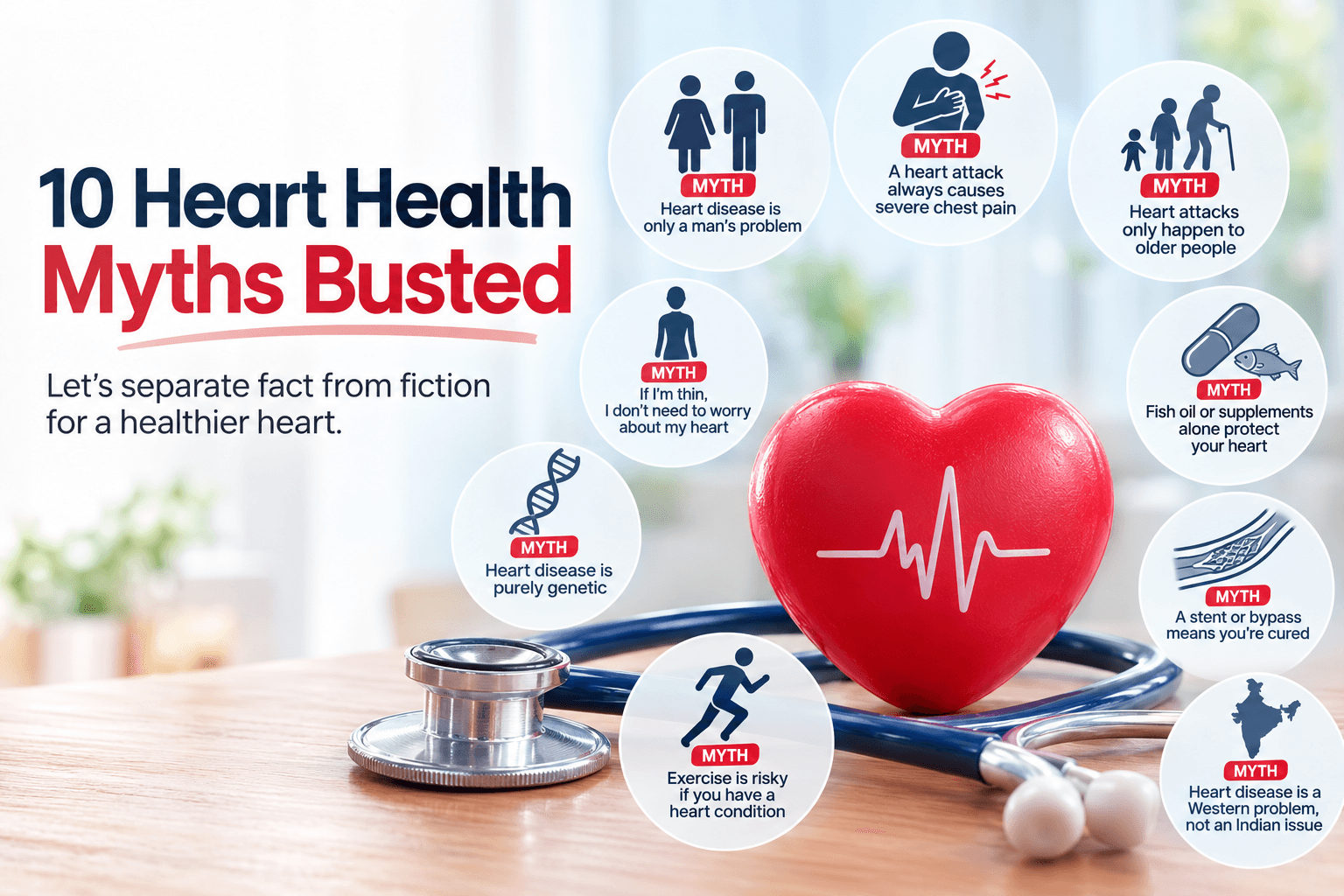


Heart health advice is everywhere from well-meaning relatives to social media reels but not all of it holds up under scrutiny. Some of these myths are simply outdated; others can actually delay someone from seeking care when it matters most. In this blog, we're busting 10 of the most common heart health myths with what current medical evidence actually shows.
Myth 1: Heart Disease Is Mostly a Man's Problem
Fact: Heart disease is the leading cause of death for women too, causing roughly 1 in 3 female deaths globally. Despite this, awareness campaigns and research have historically focused more on men, leaving many women unaware of their own risk. For a deeper look at how symptoms differ by sex, see our post on heart disease in women.
Myth 2: A Heart Attack Always Causes Crushing Chest Pain
Fact: While chest pain is common, many heart attacks come with subtler signs - jaw or shoulder pain, breathlessness, heartburn-like discomfort, or a sense of impending doom, especially in women. Some heart attacks produce almost no noticeable symptoms at all. We've covered this in detail in our post on silent heart attacks.
Myth 3: Heart Attacks Only Happen to Older People
Fact: Heart attacks in people under 40 are becoming increasingly common, in some regions, roughly 1 in 5 heart attack patients is now under 40, with rates in this age group rising steadily over the past two decades. Risk factors like smoking, obesity, diabetes, and chronic stress are appearing earlier in life, bringing heart disease with them.
Myth 4: If I'm Thin, I Don't Need to Worry About My Heart
Fact: Being a healthy weight doesn't cancel out other risk factors like high blood pressure, high cholesterol, smoking, or a poor diet. Thin individuals can and do have heart attacks, strokes, and heart failure. In fact, some research suggests that "normal weight" people with high levels of belly fat can carry heart risks similar to those who are visibly overweight - our post on weight and heart health explains this in more depth.
Myth 5: I'd Definitely Know If Something Was Wrong With My Heart
Fact: Conditions like high blood pressure, high cholesterol, and even early coronary artery disease often produce no symptoms whatsoever which is exactly why they're sometimes called "silent" risk factors. Regular checkups, not how you feel day-to-day, are the only reliable way to know your actual numbers.
Myth 6: Heart Disease Is Purely Genetic - There's Nothing I Can Do
Fact: While family history does raise your risk, the majority of heart disease, often cited at around 90% is linked to modifiable lifestyle factors like diet, smoking, physical inactivity, and poor management of blood pressure or cholesterol. A family history means extra vigilance is warranted, not that prevention is pointless.
Myth 7: Fish Oil or Vitamin Supplements Alone Protect Your Heart
Fact: Despite popular belief, current major research reviews haven't found convincing evidence that daily fish oil or multivitamin supplements meaningfully prevent heart disease in the general population. Getting omega-3s and nutrients from actual food, combined with proven habits like exercise and not smoking, remains far more evidence-backed than relying on a supplement alone.
Myth 8: Once You've Had a Stent or Bypass, You're "Cured"
Fact: Procedures like angioplasty or bypass surgery restore blood flow, but they don't reverse the underlying disease process that caused the blockage in the first place. Without continued lifestyle changes and medication adherence, new blockages can form. Life after treatment is about ongoing management, not a one-time fix.
Myth 9: Exercise Is Risky If You Already Have a Heart Condition
Fact: For most people with stable heart conditions, including coronary artery disease, appropriately guided exercise actually reduces the risk of future cardiac events and improves survival - it's a core part of cardiac rehabilitation. The key is that intensity and type of exercise should be tailored to your specific condition under medical guidance, not avoided altogether. Our guide on types of coronary artery disease touches on how activity fits into managing CAD.
Myth 10: Heart Disease Is a Western/Urban Problem, Not Really an Indian Issue
Fact: This couldn't be further from the truth. Cardiovascular disease is now the leading cause of death in India, and Indians tend to develop heart disease roughly a decade earlier than people in Western countries, often with more severe blockages at the time of diagnosis. Rising rates of diabetes, hypertension, and sedentary urban lifestyles have made this a significant nationwide concern, not a niche or foreign one.
In Conclusion
Many of these myths persist simply because they sound intuitive - "if I feel fine, I must be fine" or "I'm too young to worry." But heart disease often develops silently, and acting on outdated assumptions can genuinely delay life-saving care. Knowing the real facts, and getting regular checkups regardless of how you feel, remains one of the most effective ways to protect your heart for the long run.
Key Takeaways
- Heart disease affects women and men roughly equally, and it doesn't spare people who are thin, young, or symptom-free.
- Many heart attacks and most early heart disease, produce subtle or no symptoms at all, making regular checkups essential regardless of how you feel.
- Roughly 90% of heart disease risk comes from modifiable lifestyle factors, even with a family history.
- Supplements are not a substitute for proven habits like diet, exercise, and not smoking.
- Procedures like stents or bypass treat a blockage, not the underlying disease - ongoing lifestyle management still matters afterward.
- India faces a significant and growing heart disease burden, with earlier onset and more severe presentations than in many Western countries.
References
- Cleveland Clinic: 10 Heart Disease Myths You Shouldn't Believe
- Novant Health: The Biggest Heart Attack Myths Might Surprise You
- Gulf News: UAE Doctors Bust Myths on Heart Health on World Heart Day