
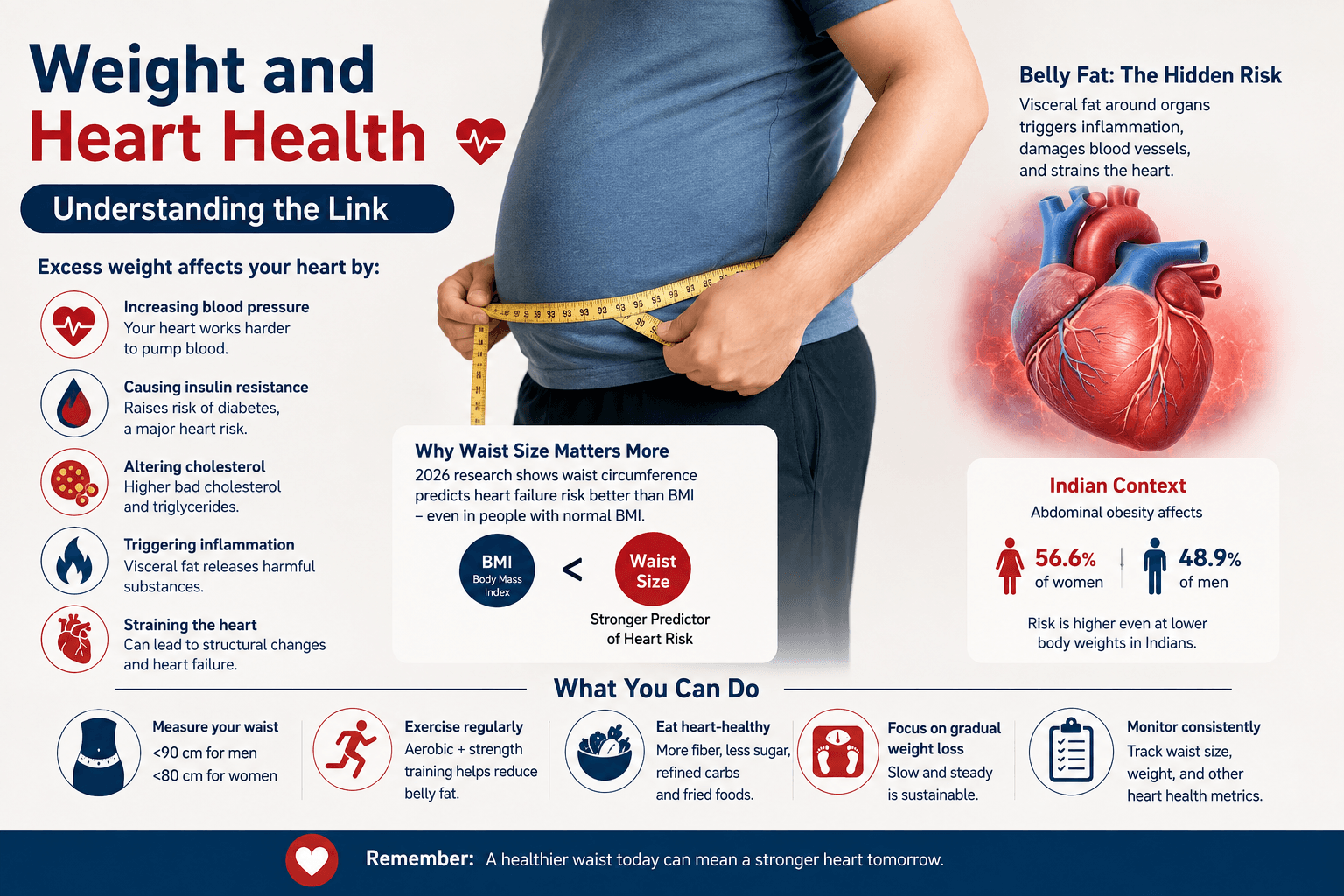


It's common knowledge that carrying extra weight isn't great for your heart but exactly how it causes harm, and which measurement actually matters most, has been shifting even in recent research. In this blog, we'll break down the real connection between weight and heart health, why doctors are increasingly focused on waist size rather than just the number on the scale, and what the science says you can do about it.
How Excess Weight Affects the Heart
Carrying excess weight doesn't just add physical load for your heart to pump against - it actively changes your body's biology in ways that increase cardiovascular risk:
- Higher blood pressure: Extra weight forces the heart to work harder to circulate blood through more tissue, raising blood pressure over time.
- Insulin resistance: Excess fat, especially around the abdomen, interferes with how your body uses insulin, increasing diabetes risk — a major heart disease risk factor in its own right.
- Unhealthy cholesterol patterns: Obesity is commonly linked to higher LDL ("bad") cholesterol and triglycerides, alongside lower HDL ("good") cholesterol.
- Chronic inflammation: Fat tissue, particularly visceral fat, is metabolically active and releases inflammatory substances that damage blood vessels over time.
- Direct strain on the heart muscle: In more severe or prolonged cases, obesity can lead to structural changes in the heart itself, contributing to conditions like heart failure.
New Research: Why Waist Size May Matter More Than BMI
Fact: A 2026 study presented at the American Heart Association's EPI|Lifestyle Scientific Sessions found that waist circumference was a stronger predictor of heart failure risk than BMI and that people with a normal BMI but a larger waist were still at meaningfully increased risk (source: American Heart Association Newsroom). In this research, inflammation accounted for roughly a quarter to a third of the increased heart failure risk linked to abdominal fat.
This matters because BMI alone can't tell you where your fat is stored — and fat stored around the abdomen (visceral fat) behaves very differently in the body compared to fat stored elsewhere.
Why Belly Fat Specifically Is So Harmful
Visceral fat doesn't just sit passively under the skin — it wraps around internal organs and is biologically active, releasing inflammatory molecules directly into the bloodstream. Over time, this contributes to insulin resistance, high blood pressure, and vascular dysfunction, gradually damaging blood vessels and straining the heart muscle. This is one reason experts now emphasize that "you can't spot-reduce" belly fat — but that overall, sustainable weight loss remains the most effective way to reduce it.
Indian Context: A Uniquely High-Risk Pattern
Fact: Nationally representative data from India's National Family Health Survey found that abdominal obesity affects an estimated 56.6% of women and 48.9% of men — a strikingly high prevalence, with rates climbing further among older adults and urban residents (source: Nature Scientific Reports, 2026).
This is especially significant because Indians and other South Asians tend to develop cardiovascular risk at lower body weights than Western populations — a pattern sometimes called the "thin-fat Indian" phenotype, where someone can appear to have a normal BMI while still carrying a disproportionate amount of visceral fat. This is exactly why waist circumference, not just weight or BMI, deserves close attention in an Indian context. Our post on key metrics to monitor during your heart health check-up covers how to track these numbers alongside your other vital heart health indicators.
How to Know If Your Weight Is a Heart Health Concern
Rather than relying on BMI alone, doctors increasingly recommend also tracking:
- Waist circumference: Under 90 cm for men and under 80 cm for women, using South Asian-specific cutoffs
- Waist-to-height ratio: Generally recommended to stay below 0.5
- BMI: Still useful as a general screening tool, ideally between 18.5–24.9, though it should be interpreted alongside waist measurements
What You Can Do:
- Measure your waist at the narrowest point of your torso, usually just above the belly button, rather than at your pants line.
- Don't rely on BMI alone if you're unsure about your risk — ask your doctor to also check your waist circumference.
What Actually Helps: Evidence-Based Weight Management for Heart Health
- Sustainable weight loss over crash dieting: Gradual, consistent weight loss is more effective at reducing visceral fat and inflammation than rapid, unsustainable diets.
- Regular physical activity: Both aerobic exercise and strength training help reduce visceral fat specifically, not just overall body weight.
- A heart-healthy diet: Reducing refined carbohydrates, added sugar, and fried foods, while increasing fiber intake, directly targets abdominal fat accumulation.
- Addressing inflammation indirectly: While there's no supplement or shortcut proven to directly reduce inflammation from belly fat, the combination of weight loss, exercise, and a balanced diet is currently the most well-supported approach.
- Consistent monitoring: Track your waist circumference periodically, not just your weight, to get a truer picture of your cardiovascular risk over time.
In Conclusion
The link between weight and heart health goes well beyond the number on a scale — where your body stores fat matters just as much, if not more, than how much you weigh overall. Emerging research increasingly points to belly fat and the inflammation it triggers as key drivers of heart risk, including conditions like heart failure, even in people whose BMI looks perfectly normal. For Indians in particular, given the pattern of higher cardiovascular risk at lower body weights, keeping an eye on waist circumference alongside weight is a simple, meaningful step toward protecting your heart.
Key Takeaways
- Excess weight raises heart disease risk through several pathways: higher blood pressure, insulin resistance, unhealthy cholesterol, and chronic inflammation.
- New 2026 research shows waist circumference predicts heart failure risk better than BMI and this holds true even for people with a normal BMI.
- Visceral (belly) fat is metabolically active and directly triggers inflammation that damages blood vessels and strains the heart.
- Abdominal obesity affects over half of Indian women and nearly half of Indian men, making waist measurement especially relevant in an Indian context.
- Track your waist circumference (below 90cm for men, 80cm for women) alongside your weight and BMI for a fuller picture of cardiovascular risk.
- Sustainable weight loss, regular exercise, and a heart-healthy diet remain the most well-supported ways to reduce visceral fat and its associated risks.
References
- American Heart Association Newsroom: Extra Belly Weight, Not BMI, Was a Stronger Predictor of Heart Failure Risk
- Nature Scientific Reports (2026): Abdominal Obesity in India: Sex-Stratified Multilevel Estimates
- Methodist DeBakey Cardiovascular Journal: The Impact of Obesity on Cardiovascular Diseases: Heart Failure
- Healthline: Excess Belly Fat, Inflammation Raise Cardiovascular Disease Risk