
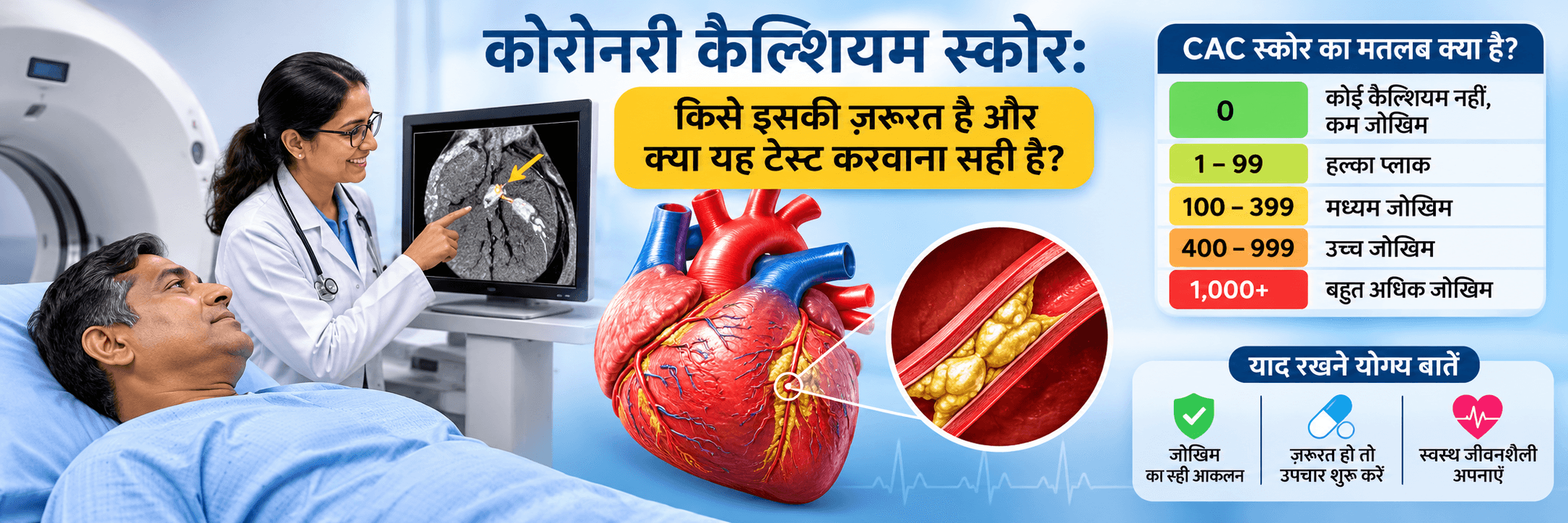


Most heart tests look for problems after they cause symptoms. A coronary calcium score is different: it’s a quick CT scan that looks for early, silent buildup in the arteries of people who feel perfectly fine. It can reveal hidden risk, and just as usefully, it can show that someone is at low risk and may not need medicines they were about to start. In this blog, we’ll explain what the score means, who should consider it, its limits, and why it matters particularly for Indians.
What Is a Coronary Calcium Score?
Over time, fatty plaque in the heart’s arteries can harden with calcium. A coronary artery calcium (CAC) scan is a non-contrast CT scan, with no dye or injection, that measures how much calcium is in these arteries. The result is reported as an Agatston score.
Why It’s Important: Calcium in the coronary arteries is direct evidence of atherosclerosis, the same process that causes heart attacks. Unlike cholesterol or blood pressure, which show risk factors, the CAC score shows whether disease has actually started.
It uses a low radiation dose, and the scan itself is quick. It does not show blockages or tell you whether an artery is narrowed. It estimates how much plaque has built up.
What Do the Numbers Mean?
CAC Score & What It Generally Means
0 : No calcified plaque detected; very low short-term risk in most people
1 to 99 : Mild plaque; individualized decision, treatment often considered, especially from age 55
100 to 399 : Moderate plaque; treatment usually recommended
400 to 999 : Extensive plaque; treated as high risk
1,000 or more : Very extensive plaque; very high risk, aggressive treatment and closer follow-up (Source: PMC mini-review, 2026)
Your result is also compared with others of your age and sex, shown as a percentile. A score at or above the 75th percentile is considered higher than expected for your age.
What the 2026 Guideline Says
Fact: The 2026 ACC/AHA dyslipidemia guideline upgraded CAC scoring from a Class 2a to a Class 1 recommendation for refining risk beyond standard risk scores (source: American College of Cardiology). In adults at intermediate risk (and selected adults at borderline risk), a CAC score above 0 supports starting cholesterol-lowering treatment, particularly at 100 or above or at the 75th percentile or higher (source: JACC).
Two key ideas:
- “Power of zero”: a score of 0 can justify deferring a statin in low- or intermediate-risk people who have no other cardiovascular conditions. Observational studies found that up to about 40% of intermediate-risk adults have a score of 0 with very low 10-year event rates, while about 25% have a score of 100 or more.
- Detectable calcium changes the target. According to a summary of the guideline, people with any detectable calcium should aim for an LDL cholesterol below 100 mg/dL, with lower goals as the score rises.
Who Might Need a Calcium Score?
The scan is most useful when the decision about treatment is uncertain. Consider asking your doctor if you:
- Are 40 or older (men) or 45 or older (women), have no symptoms or known heart disease, and your estimated risk is borderline or intermediate, according to a summary of the guideline
- Are unsure whether to start a statin or are reluctant to take one
- Have a family history of early heart disease
- Are South Asian, since this ancestry is recognized as a risk-enhancing factor (see below)
- Have diabetes or high Lp(a) and are trying to understand your true risk. See our guide on lipoprotein(a)
You’ve may already have one: if you had a chest CT scan for another reason, such as a lung scan, ask your doctor whether calcium in the heart arteries was noticed. The 2026 guideline says such incidental findings should be included in risk decisions.
Who Probably Doesn’t Need One?
- People who already have heart disease, such as a previous heart attack, stent, or bypass. The result wouldn’t change treatment.
- People with chest pain or other symptoms. Symptoms need proper evaluation, such as a stress test or CT angiography, not a screening score.
- People at very low risk, where the result is unlikely to change anything.
- Older adults. By age 70, most people already have some calcium, so the score is less helpful for deciding about treatment.
Limits: What a Score of 0 Does Not Mean
A zero score is reassuring, but it isn’t a guarantee.
- The scan only detects calcified plaque. Early or soft plaque, which hasn’t calcified yet, can be missed. This is more likely in younger people, smokers, and people with diabetes.
- It doesn’t show narrowing. A high score doesn’t tell you where the blockages are.
- It’s a snapshot. A zero today doesn’t mean zero forever, so risk factors still need attention.
Indian Context: Why This Test Matters for South Asians
Fact: Standard risk calculators, built mostly on Western populations, tend to underestimate cardiovascular risk in South Asians, which is why guidelines list South Asian ancestry as a risk-enhancing factor (source: PMC).
Data from South Asians in the US show how quickly calcium appears. The probability of having any calcium was about 20% in women and 45% in men at age 50, rising to 40% and 70% at age 60 (source: JACC Advances). These studies are from South Asians living in the US, who may differ from people living in India, but they show that early calcium is common.
Why a zero isn’t always the end of the story: in one South Asian CT angiography study, about 10% of people with a calcium score of 0 still had detectable plaque on a CT angiogram. Experts note that CAC=0 may not fully exclude early disease in younger patients, or in those with diabetes, a strong family history, high Lp(a), persistently high LDL, or symptoms (source: PMC).
The test can also work in the other direction. In one US study of South Asians, 30% of intermediate-risk participants and 54% of borderline-risk participants had a score of 0, suggesting that some people could safely avoid unnecessary medicines (source: American College of Cardiology). The participants in that study were mostly younger and relatively healthy, so the results shouldn’t be applied to everyone.
Cost in India: one commercial guide puts the test at roughly ₹2,000 to ₹6,000, depending on the city and centre (source: MedicalVault). Prices vary, so ask the diagnostic centre before booking.
So, Is It Worth It?
It’s most likely worth it if:
- You’re in the “grey zone,” with borderline or intermediate risk, and the result would change your decision about a statin or how aggressively to treat
- You’re South Asian with a family history or other risk-enhancing factors
- A score would motivate you to stick with medicines and lifestyle changes
It’s less likely to be worth it if:
- You already have heart disease or symptoms
- You wouldn’t act on the result
- You’d be falsely reassured by a zero despite strong risk factors
Questions to Ask Your Doctor
- Is my risk borderline, intermediate, or high, and would a score change my treatment?
- If my score is 0, would you still treat my other risk factors?
- If my score is high, what would we do differently?
- Is CT angiography better for my situation?
- Where can I get an ECG-gated calcium scan, and what does it cost?
What to Do After Your Result
- Score of 0: Keep healthy habits, check your numbers regularly, and repeat testing only if your doctor advises. Use our heart health checklist after 40 as a guide.
- Score above 0: Your doctor may recommend a statin and tighter blood pressure and blood sugar control. Our post on statins explains how they work.
- High score or symptoms: Your doctor may order a stress test or CT angiography. For how these differ from catheterization, see our guide on cardiac catheterization.
In Conclusion
A coronary calcium score doesn’t replace regular checkups, cholesterol tests, or a healthy lifestyle. What it does is turn an abstract risk estimate into a picture of your own arteries. For many people, especially South Asians whose risk is often underestimated, that can be the nudge that finally gets prevention started. For others, it’s reassurance that a medicine isn’t needed. Either way, the test is most valuable when you and your doctor decide in advance what you’ll do with the answer.
Key Takeaways
- A coronary calcium score is a quick, low-radiation, no-dye CT scan that measures calcified plaque in the heart arteries.
- The 2026 ACC/AHA guideline gives CAC scoring a Class 1 recommendation for refining risk in intermediate-risk adults and selected borderline-risk adults.
- A score of 0 can justify deferring a statin in low- or intermediate-risk people; a score of 100 or more (or 75th percentile or higher) generally supports treatment.
- It’s not for people with symptoms or known heart disease; they need other tests.
- A zero score doesn’t rule out soft plaque, especially in young South Asians, people with diabetes, high Lp(a), or a strong family history.
- Standard risk calculators underestimate risk in South Asians, so ancestry counts as a risk-enhancing factor.
- The test is worth it when its result would change your treatment decisions.
References
- American College of Cardiology: Lower Sooner: How the 2026 Dyslipidemia Guideline Changes Practice
- JACC: 2026 ACC/AHA Multisociety Guideline on the Management of Dyslipidemia
- PMC: Coronary Artery Calcium Scoring in 2026: Strengths, Limitations, and Optimized Clinical Use
- PMC: Coronary Plaque Beyond Calcium: Advancing Precision Risk Assessment in South Asians
- JACC Advances: Sex-Specific Coronary Artery Calcium Percentiles Across South Asian Adults: MASALA and DILWALE
- American College of Cardiology: How Many South Asians Does It Take? Coronary Artery Calcium to Refine Statin Allocation