
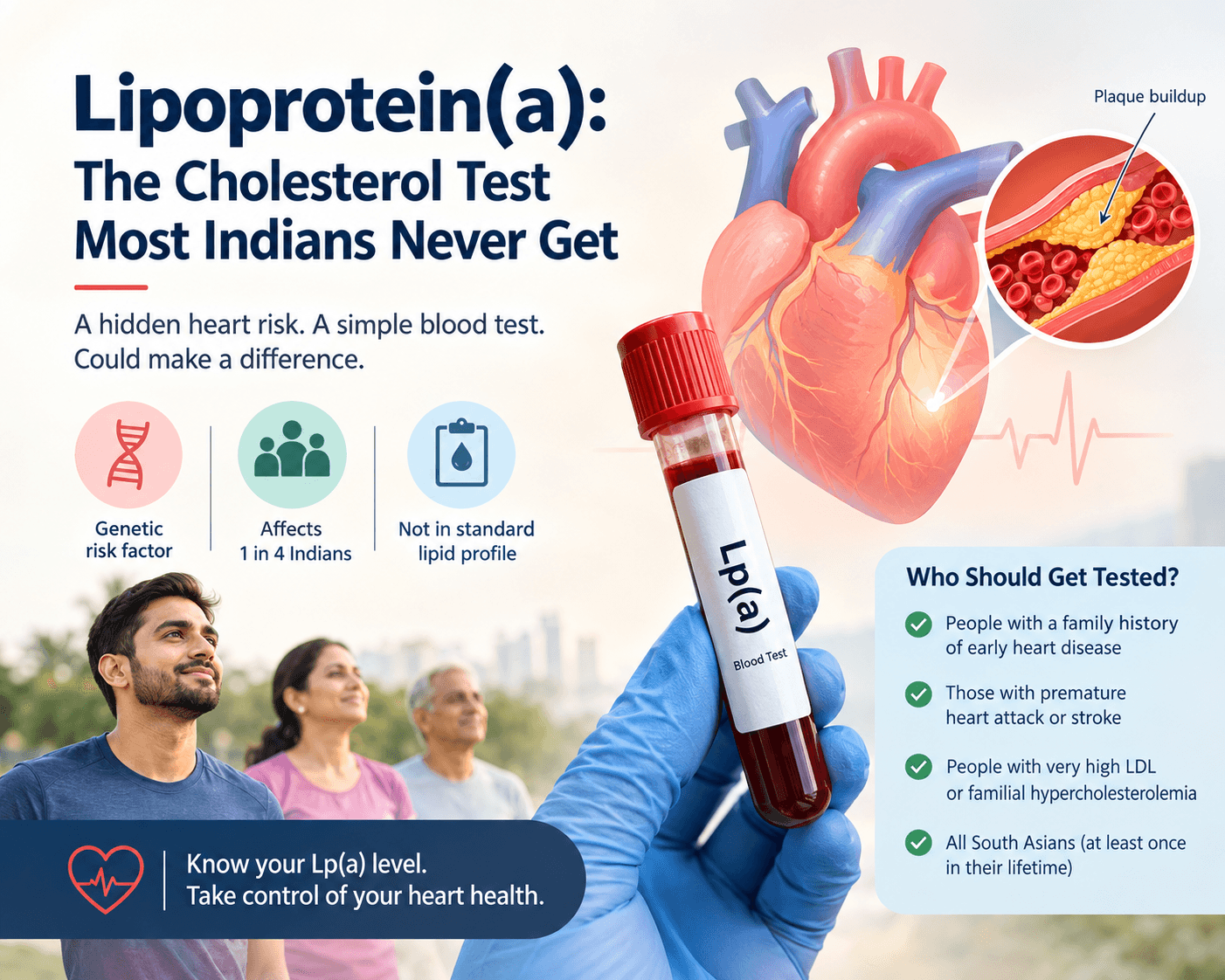


Imagine someone who exercises, eats carefully, and has a “normal” cholesterol report, yet has a heart attack at 45. Or a family where several members have heart disease in their forties and fifties despite healthy habits. In many of these cases, a lesser-known, inherited blood particle called lipoprotein(a), or Lp(a) (“L-P-little-a”), may be part of the story. It isn’t included in a standard lipid profile, so many people have never had it checked. In this blog, we’ll explain what Lp(a) is, why it matters especially for Indians, who should be tested, and what you can do if yours is high.
What Is Lipoprotein(a)?
Lp(a) is a cholesterol-carrying particle in the blood that looks like LDL (“bad”) cholesterol, with an extra protein attached to it. It is thought to harm the heart in several ways: it can promote plaque buildup in the arteries, drive inflammation, and make blood clots more likely.
Fact: Elevated Lp(a) is an independent, mainly genetically determined risk factor for cardiovascular disease (source: PMC). That means your level is largely set by your genes, stays fairly stable through life, and is not meaningfully changed by diet or exercise.
High Lp(a) has been linked to coronary artery disease, heart attack, stroke, peripheral artery disease, and narrowing of the aortic valve.
Why It Matters So Much for Indians
Fact: About 25% of South Asians have elevated Lp(a) (above 50 mg/dL), compared with roughly 20% of White populations and 10% of East Asians. Because of India’s large population, South Asians account for about a third of the world’s burden of elevated Lp(a) (source: Journal of the American Heart Association).
Indian researchers have described Lp(a) as an under-recognized genetic risk factor for severe coronary artery disease in young Indians, with high levels conferring a two- to threefold higher risk of coronary disease, similar to established risk factors like diabetes (source: PubMed). A Kerala study found that among people under 50, high Lp(a) more than tripled the odds of having coronary artery disease (source: PLOS ONE). In a North Indian acute coronary syndrome cohort, about 30% of patients had Lp(a) above 50 mg/dL (source: PMC).
Indians also tend to develop heart disease earlier, often with modest LDL cholesterol. Lp(a) may help explain some of those cases. Our post on why heart disease is no longer just an old-age problem looks at the broader trend.
Why Your Regular Cholesterol Report Misses It
A standard lipid profile reports total cholesterol, LDL, HDL, and triglycerides. Lp(a) is a separate test that has to be specifically requested. Our guides on the lipid profile and blood tests for heart disease explain what those routine reports do show.
Why It’s Important: You can have a “perfect” lipid profile and still have high Lp(a). A normal report doesn’t rule it out.
Who Should Get Tested?
Fact: The Lipid Association of India recommends a one-time Lp(a) measurement in all South Asians to help assess risk (source: Journal of the American Heart Association). The Cardiological Society of India recommends testing for Lp(a) in people with premature coronary artery disease, a family history of coronary disease, or familial hypercholesterolemia (source: PMC).
Practical reasons to ask your doctor about it:
- A heart attack, stent, or bypass at a young age (roughly before 55 in men or 65 in women)
- A family history of early heart disease, stroke, or sudden death
- Very high LDL cholesterol or suspected familial hypercholesterolemia. See our posts on hereditary heart diseases and single-gene mutations.
- Repeat heart events despite good cholesterol control
- Aortic valve narrowing found without an obvious cause
- Being South Asian, which on its own is a reason to consider a one-time test
Because levels are largely fixed from childhood, one test is usually enough. If yours is high, close relatives such as parents, siblings, and children may also benefit from testing.
Reading Your Result
Labs report Lp(a) in either mg/dL or nmol/L, and the two cannot be converted exactly, so always compare your result with the reference range printed on your own report.
Result (mg/dL) & Commonly Interpreted As
- Below about 30: Lower risk
- About 30 to 49: Borderline
- 50 and above: High
Guidelines and labs differ slightly, so ask your cardiologist how your number fits into your overall risk.
What to Do If Your Lp(a) Is High
This is where honesty matters, because the treatment picture changed very recently.
The Big Update: No Approved Lp(a)-Lowering Drug Yet
Fact: On 4 September 2026, Novartis announced that its drug pelacarsen, which lowers Lp(a) by about 80%, failed to reduce heart attacks, strokes, and cardiovascular death in the 8,323-patient Phase 3 Lp(a)HORIZON trial (source: National Lipid Association). Full results are due to be presented at the American Heart Association’s Scientific Sessions in November.
Experts are divided on what this means. Some say pelacarsen is now unlikely to be approved. Others point out that trial participants already had well-controlled LDL cholesterol, and that newer drugs, which lower Lp(a) by more than 90%, are still being tested. One of these, olpasiran, is expected to report outcomes around the end of 2026, and lepodisiran later (source: Medscape).
What this means for you today: there is currently no approved medicine that lowers Lp(a) and is proven to prevent heart attacks. A high Lp(a) is still a genuine risk marker, but “lowering the number” is not yet a proven treatment goal.
What You Can Do Now
The sensible approach is to lower your overall heart risk more aggressively:
- Bring LDL cholesterol down further. Your cardiologist may set a stricter target and consider a statin and other LDL-lowering medicines. Our post on statins explains how they work. Statins don’t lower Lp(a) itself, but they lower overall risk, which is why they are still recommended.
- Control blood pressure and blood sugar.
- Don’t smoke and keep a healthy weight, especially around the waist.
- Stay active and eat well. These don’t change Lp(a) much, but they reduce risk from every other direction.
- Get regular check-ups. Use our heart health checklist after 40 as a guide.
- If you’ve already had a heart event, our guide on preventing a second heart attack covers medicines and targets.
- Ask about a coronary calcium scan or other imaging if your doctor feels your risk is still unclear.
Avoid unproven supplements or “Lp(a) cleanse” products. There is no diet or supplement that has been shown to meaningfully lower Lp(a).
Common Questions
1) Can I lower my Lp(a) with diet or exercise?
Not meaningfully. It is genetically determined, which is why other risk factors deserve extra attention.
2) Does a high Lp(a) mean I will definitely have a heart attack?
No, It raises risk but doesn’t make a heart attack inevitable. Many people with high Lp(a) never develop heart disease, especially when other risk factors are well controlled.
3) Should my children be tested?
If your Lp(a) is high, ask your doctor about testing first-degree relatives. Since levels are stable from early life, a single test can be informative.
In Conclusion
Lipoprotein(a) is one of the most important heart risk factors that most people have never heard of, and it is unusually common in Indians. A single blood test can reveal it. Although the first big Lp(a)-lowering drug trial has just failed, that doesn’t make the test pointless. Knowing your number tells you and your doctor to be more aggressive about everything you can control, and it can alert your family. Research continues, and the answer on Lp(a)-lowering drugs may look different within a couple of years.
Key Takeaways
- Lp(a) is an inherited cholesterol-like particle that raises the risk of heart attack, stroke, and aortic valve disease.
- About 1 in 4 South Asians have high Lp(a) (above 50 mg/dL), and it is not part of a standard lipid profile.
- A one-time test is recommended by Indian guidelines for South Asians, and especially for those with premature heart disease or a strong family history.
- Diet and exercise do not meaningfully change your Lp(a) level.
- As of October 2026, no Lp(a)-lowering drug is approved; the first major outcomes trial (pelacarsen) did not reduce cardiovascular events, and others are still being tested.
- If your Lp(a) is high, control every other risk factor aggressively, starting with LDL cholesterol, blood pressure, blood sugar, and tobacco.
- If your level is high, talk to your family about testing.
References
- Journal of the American Heart Association: Role of Lipoprotein(a) in Atherosclerotic Cardiovascular Disease in South Asian Individuals
- PubMed: Lipoprotein(a): An Underrecognized Genetic Risk Factor for Malignant Coronary Artery Disease in Young Indians
- PMC (Cardiological Society of India): CSI Clinical Practice Guidelines for Dyslipidemia Management: Executive Summary
- PLOS ONE: Association of Lipoprotein(a) With Coronary Artery Disease in a South Asian Population
- National Lipid Association: Top Line Results From the Phase 3 Lp(a)HORIZON Trial
- Medscape: Not So Fast on Throwing Out the Lp(a) Hypothesis, These Experts Say