
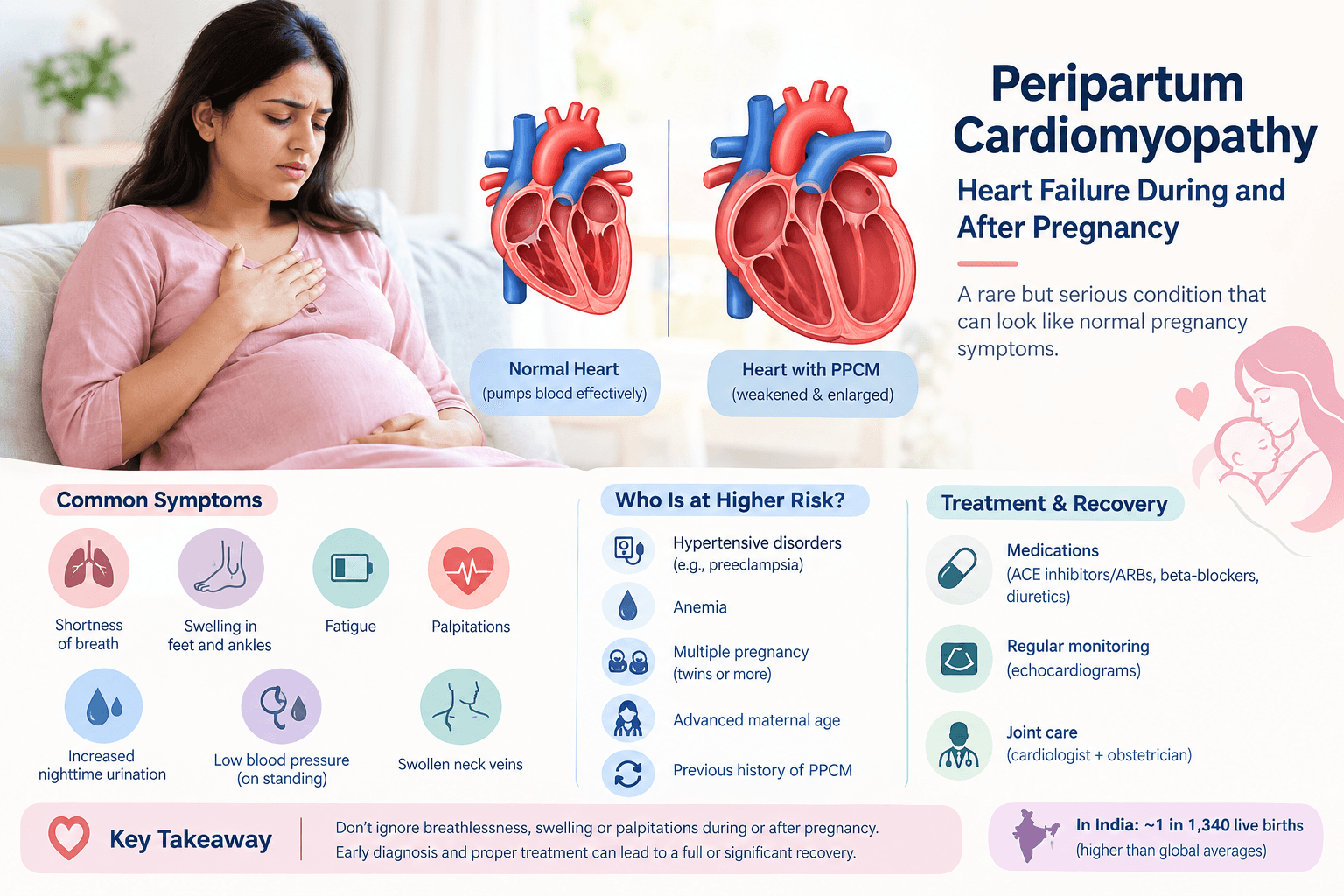


Pregnancy naturally comes with breathlessness, swollen ankles, and fatigue which is exactly what makes peripartum cardiomyopathy (PPCM) so easy to miss. This rare but serious condition causes the heart muscle to weaken toward the end of pregnancy or in the months after delivery, and its early symptoms look almost identical to normal pregnancy discomfort. In this blog, we'll explain what PPCM is, who's at risk, how it's diagnosed, and what recovery typically looks like including how common it is in India specifically.
What Is Peripartum Cardiomyopathy?
Peripartum cardiomyopathy is a form of heart failure that develops in the last month of pregnancy or within the first five months after delivery, in women with no prior history of heart disease. It causes the left ventricle the heart's main pumping chamber to weaken and enlarge, reducing its ability to pump blood effectively.
Fact: Globally, PPCM is estimated to affect roughly 1 in 2,000 pregnancies, though rates vary considerably by region from as low as 1 in 20,000 in parts of Japan to as high as 1 in 100 in Nigeria, which has one of the highest reported incidences in the world (source: PMC).
Indian Context: A pooled analysis of Indian studies found an incidence of roughly 1 in 1,340 live births considerably higher than global averages with most Indian women developing PPCM in the postpartum period rather than before delivery, at a mean age of around 27 (source: Journal of Clinical and Preventive Cardiology). Delayed recognition remains a significant challenge in India, largely because PPCM's symptoms overlap so closely with the normal discomforts of late pregnancy.
Why PPCM Is So Easy to Miss
The symptoms of peripartum cardiomyopathy closely mirror what many women experience in a completely normal pregnancy, which is exactly why diagnosis is so often delayed:
- Shortness of breath during activity or while lying down
- Swelling in the feet, ankles, or legs
- Fatigue
- Heart palpitations or a racing/skipping heartbeat
- Increased nighttime urination
- Low blood pressure upon standing
- Swollen neck veins
Why It's Important: Because these symptoms are so common in normal pregnancy, many women don't seek medical attention until symptoms become severe and some don't experience noticeable symptoms until after their baby is already born.
What You Can Do:
- If breathlessness, swelling, or fatigue feels disproportionate to what's expected, or worsens rapidly rather than gradually, raise it with your doctor rather than assuming it's "just pregnancy."
- Persistent palpitations or breathlessness while lying flat, in particular, deserve prompt evaluation.
Who Is at Higher Risk
- Hypertensive disorders of pregnancy: Conditions like preeclampsia are strongly linked to PPCM, and were present in nearly half of patients in the Indian pooled analysis.
- Anemia: Also commonly associated with PPCM in Indian studies, and linked to worse outcomes for the baby.
- Multiple pregnancy (twins or more): A well-established risk factor globally.
- Advanced maternal age: Risk rises somewhat with age, though PPCM in India tends to occur at a relatively young mean age.
- A prior history of PPCM: Significantly raises the risk of recurrence in future pregnancies.
How Peripartum Cardiomyopathy Is Diagnosed
PPCM is considered a "diagnosis of exclusion" meaning doctors first need to rule out other possible causes of heart failure before confirming this specific diagnosis.
- Echocardiogram: The key diagnostic test, showing a weakened heart muscle and reduced ejection fraction (a measurement of how well the heart pumps).
- ECG: May reveal abnormalities like an irregular heart rhythm.
- Blood tests: Used to help rule out other causes of heart failure.
Treatment and Recovery
Treatment for PPCM generally follows standard heart failure protocols, adapted for pregnancy and breastfeeding safety:
- Medications: Typically includes ACE inhibitors or ARBs (after delivery), beta-blockers, and diuretics to manage fluid buildup with medication choices carefully adjusted if the patient is still pregnant or breastfeeding.
- Close monitoring: Regular echocardiograms to track how well heart function is recovering, typically checked around the six-month mark.
- Specialist care: Often managed jointly by a cardiologist and obstetrician, given the overlapping maternal and fetal considerations.
What Recovery Typically Looks Like
Fact: Recovery from PPCM varies significantly. Roughly 46% of patients recover normal heart function within six months, while around 23% remain with significantly reduced heart function and go on to develop chronic heart failure (source: PMC). A lower ejection fraction at the time of diagnosis is one of the strongest predictors of a poorer outcome.
Why It's Important: Even among women who do recover normal heart function, close monitoring shouldn't stop there roughly 1 in 5 women who recover from PPCM experience a heart failure relapse later in life, and some experience reduced exercise capacity even after their heart function returns to a healthy range.
Considerations for Future Pregnancies
This is one of the most important conversations for any woman who has had PPCM. Recurrence in a subsequent pregnancy occurs in a significant proportion of cases estimates range widely, from roughly 10% to 50% and outcomes tend to be worse when heart function hasn't fully recovered before conceiving again.
What You Can Do:
- Discuss family planning and contraception with your cardiologist and obstetrician before considering another pregnancy.
- If considering a future pregnancy, aim to do so only once your ejection fraction has been confirmed as recovered and understand that even full recovery doesn't eliminate all risk.
In Conclusion
Peripartum cardiomyopathy is rare, but it's a genuine medical emergency hiding behind symptoms that look deceptively ordinary. The single most protective thing an expecting or new mother can do is not dismiss breathlessness, swelling, or palpitations as "just part of pregnancy" if they feel severe, sudden, or out of proportion. With early diagnosis and proper treatment, many women go on to make a full or significant recovery but the earlier it's caught, the better that outcome tends to be.
Key Takeaways
- Peripartum cardiomyopathy is heart failure that develops in the last month of pregnancy or within five months after delivery, in women with no prior heart disease.
- Its symptoms, breathlessness, swelling, fatigue, palpitations closely mimic normal pregnancy, which is why it's so often missed.
- Indian studies show an incidence of roughly 1 in 1,340 live births, notably higher than global averages.
- Hypertensive disorders of pregnancy and anemia are commonly linked to PPCM in Indian patients specifically.
- About 46% of patients recover normal heart function within six months, while roughly 23% develop chronic heart failure.
- Women who've had PPCM should discuss future pregnancy risk carefully with their cardiologist, given meaningful recurrence risk.
References
- Cleveland Clinic: Peripartum Cardiomyopathy: Symptoms & Treatment
- UPMC: Peripartum Cardiomyopathy Causes, Symptoms, and Treatment
- PMC: Peripartum Cardiomyopathy in India
- Journal of Clinical and Preventive Cardiology: Peripartum Cardiomyopathy in Indian Population: A Pooled Analysis