
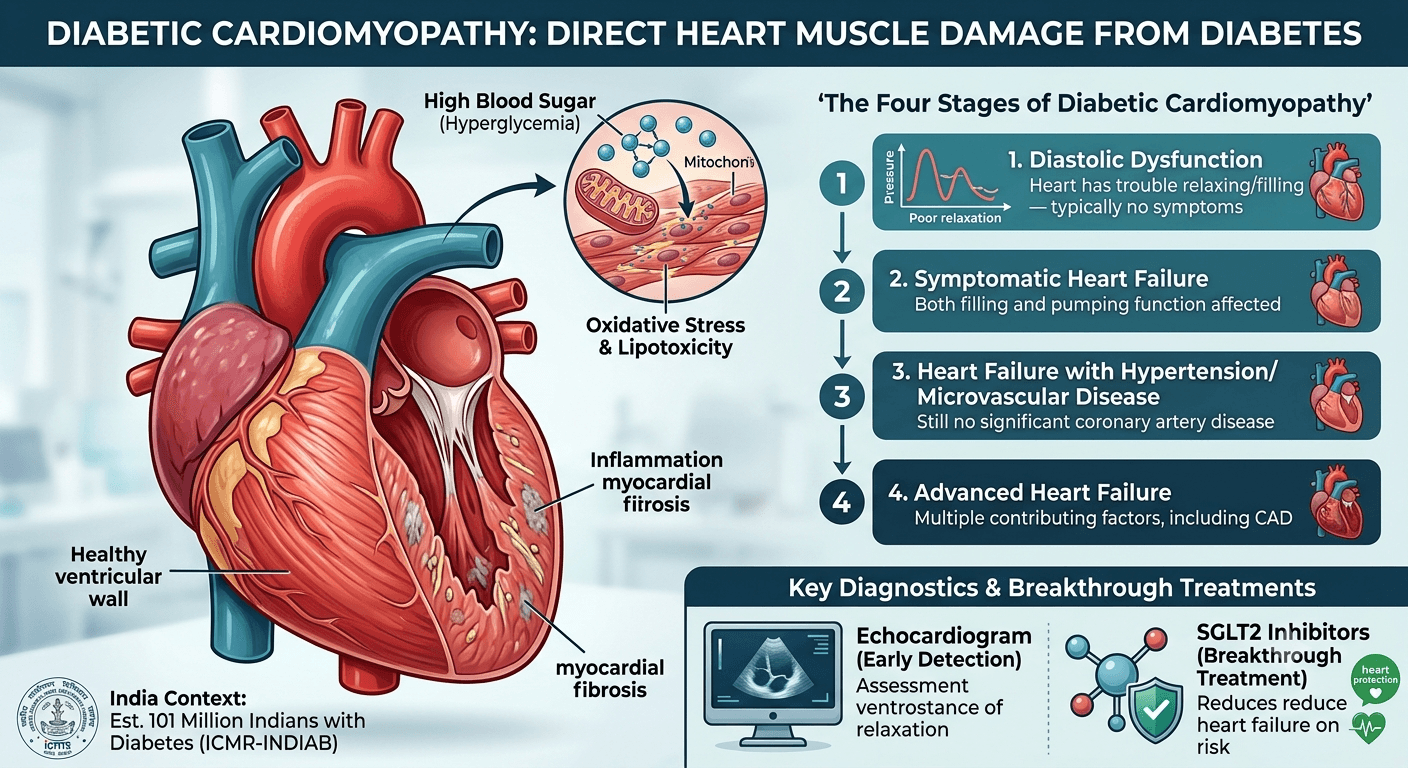


Most people know that diabetes raises heart attack risk by clogging arteries but there's a second, less talked-about way diabetes damages the heart, one that has nothing to do with blocked blood vessels at all. It's called diabetic cardiomyopathy, and it involves diabetes directly weakening the heart muscle itself, often silently, years before any symptoms appear. In this blog, we'll explain what makes this condition distinct, how it progresses, and what current treatment approaches look like.
If you'd like a broader look at how diabetes affects the heart overall, our guide on managing diabetes to protect your heart is a good starting point before diving into this more specific condition.
What Makes Diabetic Cardiomyopathy Different
Fact: Diabetic cardiomyopathy is specifically defined as myocardial (heart muscle) disease occurring in people with diabetes that is not explained by coronary artery disease, high blood pressure, or valve disease (source: SAGE Open Medicine). In other words, this isn't about blocked arteries starving the heart of blood - it's diabetes itself, through years of high blood sugar and related metabolic changes, directly altering how the heart muscle functions.
This distinction matters because it means a diabetic patient can develop significant heart dysfunction even if their arteries look completely clear on an angiogram.
How Diabetes Damages the Heart Muscle Directly
Several overlapping mechanisms are thought to drive this process:
- Chronic high blood sugar (hyperglycemia): Damages heart muscle cells over time and disrupts normal energy production within them.
- Fatty acid buildup (lipotoxicity): Excess fat accumulation in heart muscle cells impairs their normal function.
- Oxidative stress: Chronic high blood sugar increases harmful oxidative stress, damaging the mitochondria (the "power plants") inside heart muscle cells.
- Myocardial fibrosis: Over time, the heart muscle develops stiffness and scarring, making it harder for the heart to relax and fill with blood between beats - a pattern of dysfunction closely related to what we've covered in systolic vs. diastolic heart failure.
The Four Stages of Diabetic Cardiomyopathy
Diabetic cardiomyopathy progresses gradually, often without any symptoms in its early stages:
Stage & What's Happening
Stage 1: Diastolic dysfunction (the heart has trouble relaxing/filling) with a normal ejection fraction - typically no symptoms
Stage 2: Symptomatic heart failure, with both filling and pumping function affected
Stage 3: Symptomatic heart failure with contributions from high blood pressure or microvascular disease, but still no significant coronary artery disease
Stage 4: Symptomatic heart failure with multiple contributing factors, including coronary artery disease
Why It's Important: By the time a patient reaches Stage 2, annual mortality rates can climb as high as 20%, and these patients are roughly twice as likely to be hospitalized for heart failure compared to non-diabetic patients with a similar type of heart failure - a condition explained further in our post on what congestive heart failure is. This is precisely why catching diabetic cardiomyopathy in its silent Stage 1 phase matters so much.
Why It Often Goes Undetected
Diabetic cardiomyopathy has a long, asymptomatic phase - sometimes lasting years during which the heart is quietly stiffening and remodeling without producing any noticeable symptoms. Because routine diabetes care often focuses heavily on blood sugar, cholesterol, and standard cardiovascular screening for blocked arteries, this specific, artery-independent form of heart damage can be easy to overlook unless a doctor is specifically looking for it.
What You Can Do:
- If you have diabetes, ask your doctor whether an echocardiogram is appropriate, even without cardiac symptoms - this is currently the main way diastolic dysfunction is detected early. Our guide on what an echocardiogram shows explains exactly what doctors are looking for in this test, including ejection fraction and chamber function.
- Watch for early, subtle signs like reduced exercise tolerance, mild breathlessness during activity, or unusual fatigue, and mention these even if they seem minor.
Indian Context: A Rapidly Growing Risk Pool
Fact: According to the landmark ICMR-INDIAB study, India's largest nationally representative survey on metabolic disease - an estimated 101 million Indians had diabetes in 2021, alongside 136 million with prediabetes (source: The Lancet Diabetes & Endocrinology). Given that diabetic cardiomyopathy develops specifically as a consequence of long-term diabetes, this scale of diabetes prevalence in India represents an enormous and likely under-recognized - pool of people at risk for this specific, artery-independent form of heart damage.
How Diabetic Cardiomyopathy Is Diagnosed
- Echocardiogram: The primary diagnostic tool, capable of detecting diastolic dysfunction often the earliest sign well before symptoms appear.
- Advanced imaging techniques: Tools like tissue Doppler imaging and strain rate imaging can detect even more subtle, early changes in heart muscle function.
- Ruling out other causes: Since this is a diagnosis of exclusion, doctors need to confirm there's no significant coronary artery disease, valve disease, or uncontrolled hypertension driving the heart dysfunction instead.
Treatment: What's Changed in Recent Years
For a long time, there was no specific treatment aimed at diabetic cardiomyopathy itself only general heart failure management. That's changed significantly with newer diabetes medications.
SGLT2 Inhibitors: A Genuine Breakthrough
Fact: Large clinical trials have shown that SGLT2 inhibitors - a class of diabetes medication significantly reduce heart failure hospitalization and cardiovascular death in diabetic patients, effects strong enough that these drugs are now prescribed specifically as heart failure treatments, not just for blood sugar control (source: Circulation Research, American Heart Association).
Other Management Approaches
- Blood sugar control: Good glycemic management remains foundational, though it alone doesn't fully prevent diabetic cardiomyopathy.
- Metformin: Associated with lower mortality risk in diabetic patients who already have heart failure.
- Standard heart failure medications: Once symptomatic heart failure develops, treatment follows similar principles to heart failure management generally. If you're newly prescribed any of these, our guide on how to take heart medicines safely covers habits worth building from day one.
- Lifestyle measures: Regular exercise, weight management, and blood pressure control all help reduce additional strain on an already vulnerable heart muscle.
In Conclusion
Diabetic cardiomyopathy is a reminder that diabetes doesn't just threaten the heart through clogged arteries - it can quietly damage the heart muscle itself, often years before any symptoms show up. With diabetes prevalence in India now affecting well over 100 million people, awareness of this specific, artery-independent pathway matters more than ever. The encouraging development is that newer diabetes medications, particularly SGLT2 inhibitors, are proving genuinely effective at protecting the heart making proactive screening and treatment more valuable than ever for anyone living with diabetes. For more on the broader relationship between diabetes and heart health, explore our full Healthy Heart Habits section on Swasth Hriday.
Key Takeaways
- Diabetic cardiomyopathy is heart muscle damage caused directly by diabetes, occurring even without blocked coronary arteries.
- It progresses through four stages, starting with silent diastolic dysfunction that can go undetected for years.
- India's diabetes burden - an estimated 101 million people as of 2021 - represents a significant at-risk population for this condition.
- Echocardiography is the primary way to detect diabetic cardiomyopathy early, often before any symptoms appear.
- SGLT2 inhibitors have emerged as a genuine breakthrough, meaningfully reducing heart failure risk in diabetic patients.
- If you have diabetes, ask your doctor about periodic heart function screening, even in the absence of cardiac symptoms.
References
- Circulation Research (AHA Journals): Diabetic Cardiomyopathy
- SAGE Open Medicine: Diabetic Cardiomyopathy: Prevalence, Determinants and Potential Treatments
- The Lancet Diabetes & Endocrinology: Metabolic Non-Communicable Disease Health Report of India (ICMR-INDIAB-17)
- BMC Medicine: Prevalence of Diabetic Cardiomyopathy in Patients With Type 2 Diabetes