
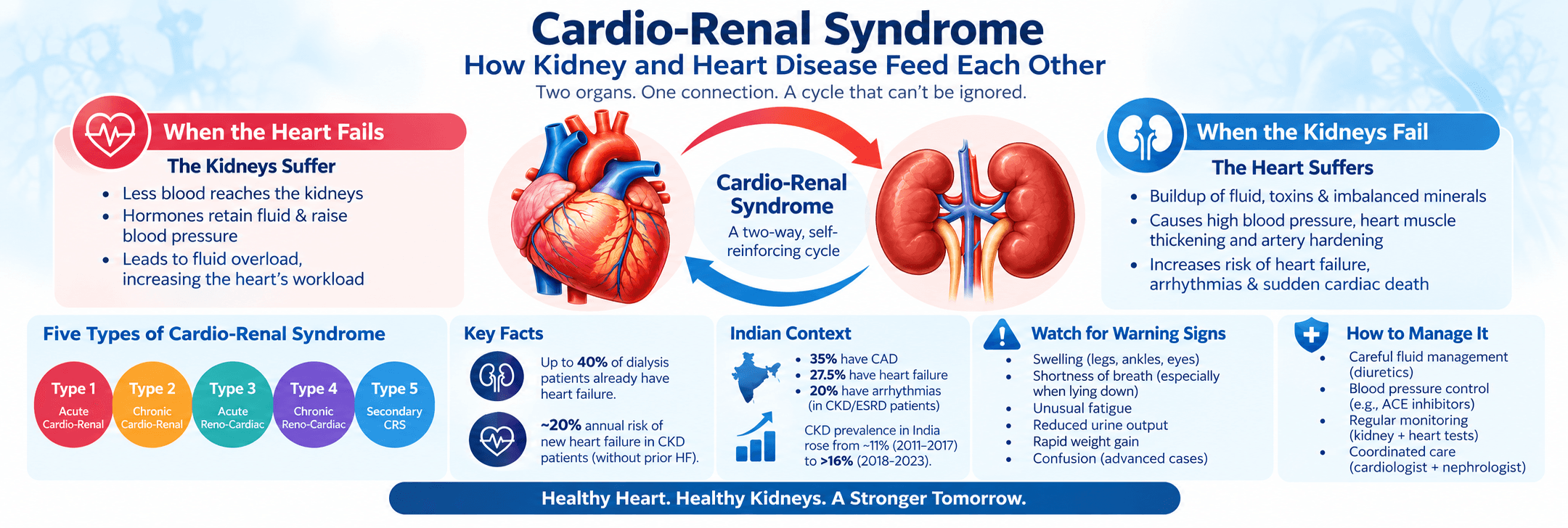


The heart and kidneys work as a tightly linked team - the heart pumps blood, and the kidneys filter it, and each depends entirely on the other doing its job well. When one starts to fail, it doesn't just affect that one organ; it actively drags the other down too, creating a downward spiral doctors call cardio-renal syndrome. In this blog, we'll explain how this two-way relationship works, why it matters so much for patients with either heart or kidney disease, and what can be done to break the cycle.
What Is Cardio-Renal Syndrome?
Cardio-renal syndrome (CRS) describes a condition where dysfunction in either the heart or the kidneys triggers dysfunction in the other, creating a self-reinforcing cycle. It isn't one single disease - it's a relationship between two failing organ systems, and doctors classify it into five distinct subtypes based on which organ fails first and over what timeframe.
Fact: Up to 40% of patients with chronic kidney disease who start dialysis already have heart failure, and among those who don't, the annual risk of developing new heart failure is estimated at around 20% (source: PMC).
The Five Types of Cardio-Renal Syndrome
Type & What Happens
- Type 1 (Acute Cardio-Renal): A sudden heart problem (like acute heart failure) causes sudden kidney injury
- Type 2 (Chronic Cardio-Renal): Long-standing heart disease gradually causes chronic kidney disease
- Type 3 (Acute Reno-Cardiac): A sudden kidney problem (like acute kidney injury) causes sudden heart dysfunction
- Type 4 (Chronic Reno-Cardiac): Long-standing chronic kidney disease gradually leads to heart disease, often progressing toward heart failure
- Type 5 (Secondary CRS): A separate systemic illness, such as sepsis, damages both organs simultaneously
Why It's Important: Understanding which type applies to a patient genuinely matters for treatment - a heart problem causing kidney trouble (Type 1/2) is managed differently than a kidney problem driving heart dysfunction (Type 3/4), even though both eventually create the same vicious, self-perpetuating cycle.
How the Heart and Kidneys Damage Each Other
When the Heart Fails, the Kidneys Suffer
When the heart can't pump blood effectively, less blood reaches the kidneys. The kidneys respond by activating hormonal systems designed to retain fluid and raise blood pressure -
a survival mechanism that backfires in heart failure, since it causes further fluid overload, forcing the already-struggling heart to work even harder.
When the Kidneys Fail, the Heart Suffers
Chronic kidney disease causes a buildup of fluid, toxins, and imbalanced minerals (like calcium and phosphate) in the bloodstream. Over time, this contributes to high blood pressure, thickening of the heart muscle (left ventricular hypertrophy), and accelerated hardening of the arteries - all of which raise the risk of heart failure, arrhythmias, and even sudden cardiac death.
Indian Context: A Significant and Growing Overlap
Fact: A cross-sectional Indian study of chronic kidney disease and end-stage renal disease patients found that 35% had coronary artery disease, 27.5% had heart failure, and 20% had arrhythmias - figures that align closely with the global burden of cardiovascular complications in kidney disease (source: PMC). India's overall chronic kidney disease burden has also been rising sharply, with prevalence estimates climbing from roughly 11% between 2011–2017 to over 16% between 2018–2023, placing India among the countries with the highest CKD caseloads globally.
This overlap matters enormously in practice: a patient being treated for heart failure in India may also be silently developing kidney impairment, and vice versa which is one reason kidney function is routinely monitored during procedures like cardiac catheterization, since the contrast dye used is processed by the kidneys and can pose extra risk for patients with reduced kidney function.
Warning Signs Worth Watching For
Because cardio-renal syndrome involves two organs at once, symptoms can be easy to misattribute to just one system:
- Swelling in the legs, ankles, or around the eyes
- Shortness of breath, especially when lying flat
- Unusual fatigue
- Reduced urine output or changes in urine appearance
- Rapid weight gain from fluid retention
- Confusion or difficulty concentrating, in more advanced cases
What You Can Do: If you have either heart disease or kidney disease, don't assume new symptoms are only related to the condition you already know about - mention any of the above to your doctor so both organ systems can be evaluated together.
Managing Cardio-Renal Syndrome
Treatment requires careful balance, since medications that help one organ can sometimes strain the other:
- Careful fluid management: Diuretics help remove excess fluid, but need careful dosing to avoid further kidney strain.
- Blood pressure control: Managing hypertension protects both the heart and kidneys simultaneously, making it one of the most important shared priorities. Medications like ACE inhibitors are commonly used precisely because they offer protective benefits for both organs, though kidney function needs close monitoring while on them.
- Regular monitoring: Kidney function tests and cardiac assessments are typically done together, rather than in isolation, once cardio-renal syndrome is suspected.
- Coordinated specialist care: Because of the two-way relationship between these organs, cardiologists and nephrologists often need to work together closely on a single patient's treatment plan.
In Conclusion
The heart and kidneys are far more interconnected than most people realize, and cardio-renal syndrome is a powerful reminder that treating one organ in isolation can sometimes come at the expense of the other. With India's rising burden of both chronic kidney disease and heart disease, recognizing this two-way relationship and getting both systems checked together rather than separately - is an increasingly important part of protecting long-term health.
Key Takeaways
- Cardio-renal syndrome describes a two-way, self-reinforcing relationship between heart and kidney dysfunction, classified into five distinct subtypes.
- Up to 40% of dialysis patients already have heart failure, and kidney disease patients face significantly elevated cardiovascular risk.
- In India, over a third of chronic kidney disease patients have coronary artery disease, and more than a quarter have heart failure.
- Symptoms like swelling, breathlessness, and reduced urine output can point to problems in either organ - don't assume they're related to only one condition.
- Treatment requires careful balance and coordinated care between cardiologists and nephrologists, since interventions for one organ can affect the other.
References
- PMC: All-Cause and Cardiovascular-Related Mortality in CKD Patients With and Without Heart Failure
- PMC: Prevalence of Cardiovascular Disease in Patients With CKD and ESRD in India
- PMC: Mechanisms and Modulation of Oxidative/Nitrative Stress in Type 4 Cardio-Renal Syndrome
- Oxford Academy: Chronic Kidney Disease India: Burden, Risks, and Future Projections