
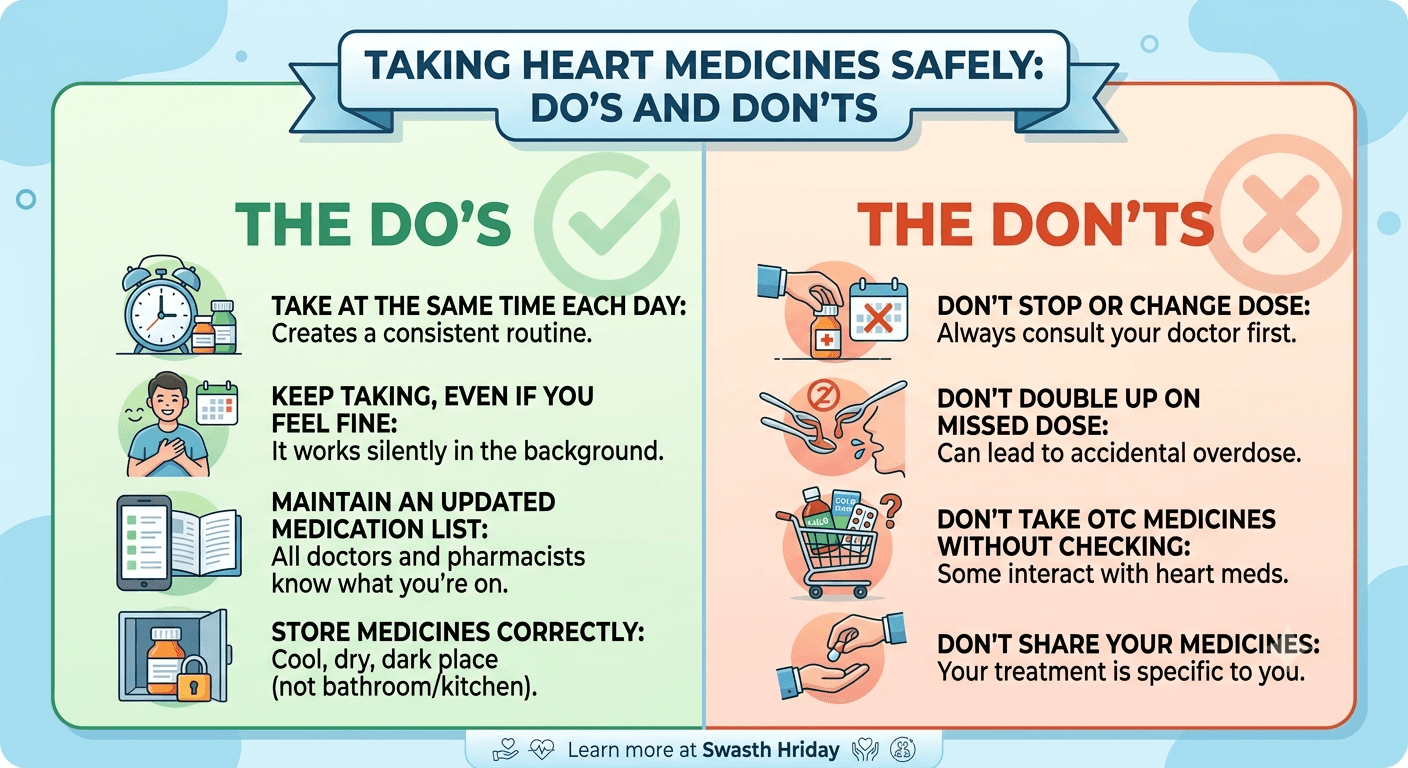


Getting a prescription for a heart condition is only half the job — the medicine only works if it's taken correctly, consistently, and safely. Yet studies across the world, including in India, show that a large number of patients don't take their heart medications as directed, often without realizing how much this can affect their treatment. In this blog, we'll walk through the essential do's and don'ts of taking heart medicines safely, so you get the full benefit of your treatment while avoiding common, preventable mistakes.
If you're just getting familiar with what's actually in your prescription, our overview of cardiac medications is a good place to start before diving into these safety tips.
Why Taking Heart Medicines Correctly Matters
Heart medications work by maintaining a steady, effective level in your bloodstream. Skipping doses, doubling up, or stopping suddenly can throw this balance off - sometimes with serious consequences.
Fact: Medication non-adherence is one of the leading causes of preventable hospitalizations and repeat doctor visits among cardiovascular patients worldwide (source: American College of Cardiology / CardioSmart).
Indian Context: A study of rural Indian patients found that only about 21–32% were properly adherent to their prescribed cardiovascular medicines for conditions like hypertension, heart failure, and ischemic heart disease — meaning the majority weren't taking their medicines as directed (source: PMC study on rural Indian patients). Poor adherence like this significantly raises the risk of avoidable complications and hospital readmissions.
The Do's of Taking Heart Medicines Safely
1. Take Medicines at the Same Time Every Day
Why It's Important: A consistent schedule keeps a steady level of medicine in your bloodstream, which is essential for it to work properly.
What You Can Do:
- Link your medicine to an existing daily habit, like breakfast or brushing your teeth.
- Use a pillbox marked by day of the week, or set a phone alarm as a reminder.
2. Keep Taking Your Medicine Even If You Feel Fine
Why It's Important: Many heart medicines for blood pressure, cholesterol, or heart failure - work silently in the background. Feeling well is often a sign the medicine is working, not a sign you can stop.
What You Can Do:
- Continue your medication as prescribed unless your doctor specifically tells you to stop.
- If you're tempted to stop due to cost or convenience, talk to your doctor first - there may be other options.
3. Keep an Updated List of All Your Medicines
Why It's Important: An accurate list helps every doctor, pharmacist, and even emergency responders understand exactly what you're taking, reducing the risk of dangerous drug interactions.
What You Can Do:
- Include prescription drugs, over-the-counter (OTC) medicines, and any herbal or vitamin supplements.
- Carry this list with you, or save it on your phone, and update it whenever something changes.
4. Use the Same Pharmacy for All Prescriptions
Why It's Important: This allows your pharmacist to track your complete medication history and flag potential interactions before they become a problem.
5. Store Medicines Correctly
Why It's Important: Heat, light, and moisture can degrade many medicines, making them less effective.
What You Can Do:
- Store medicines in a cool, dry, dark place not the bathroom or kitchen, where humidity and heat are common.
- Keep them safely out of reach of children and pets.
6. Tell Your Doctor About Side Effects
Why It's Important: Some side effects can be managed with a dose adjustment or a different medicine, but only if your doctor knows about them. If you're currently dealing with symptoms like fatigue or dizziness, our guide on what to do if your heart medication causes side effects covers this in detail.
The Don'ts of Taking Heart Medicines Safely
1. Don't Stop or Change Your Dose on Your Own
Why It's Important: Suddenly stopping certain heart medicines such as beta-blockers can trigger a dangerous rebound effect, sometimes worsening your condition rapidly. If you're weighing beta-blockers against another option, our comparison of beta-blockers vs. ACE inhibitors explains how each works and why abrupt changes matter.
What You Can Do:
- Always consult your doctor before making any changes, even if you're experiencing mild side effects.
2. Don't Double Up on a Missed Dose
Why It's Important: Taking two doses at once to "catch up" can lead to an accidental overdose.
What You Can Do:
- If you miss a dose, take it as soon as you remember - unless it's almost time for your next dose, in which case ask your doctor whether to skip it or take it.
- Never take an extra dose just because you're not feeling well.
3. Don't Take Over-the-Counter Medicines Without Checking First
Why It's Important: Certain common OTC products including some cold and cough remedies, decongestants, and even certain antacids can interact with heart medications or raise blood pressure. This is especially relevant if you're on blood pressure medication, since several common OTC drugs can counteract its effect.
What You Can Do:
- Ask your doctor or pharmacist before starting any new OTC medicine, herbal remedy, or supplement.
4. Don't Share Your Medicines With Anyone Else
Why It's Important: A medicine that's safe and effective for you could be harmful for someone with a different condition, weight, or set of medications. This applies especially to blood thinners, where the wrong dose for the wrong person can cause serious bleeding risk.
5. Don't Take Medicine in Low Light or While Distracted
Why It's Important: Mistaking one pill bottle for another is a common, avoidable error.
What You Can Do:
- Always turn on a light and double-check the label before taking any medicine.
6. Don't Cut Costs by Skipping Doses
Why It's Important: Taking less than the prescribed amount to stretch your supply reduces the medicine's effectiveness and can allow your condition to progress.
What You Can Do:
- If cost is a genuine concern, speak to your doctor about more affordable alternatives rather than reducing your dose silently.
Traveling With Heart Medicines
- Keep your medicines in a carry-on bag or bag you keep with you, never in checked luggage.
- Carry a copy of your prescriptions and your doctor's contact information.
- If crossing time zones, ask your doctor how to adjust your dosing schedule.
- Pack a few extra days' supply in case of travel delays.
In Conclusion
Heart medicines are only as effective as the routine behind them. A consistent schedule, an updated medication list, safe storage, and open communication with your doctor and pharmacist are simple habits that make a significant difference to how well your treatment actually works. When in doubt about any medicine, dose, or interaction, always check with a professional rather than guessing. For more on managing specific medications, explore our full Heart Medications section on Swasth Hriday.
Key Takeaways
- Take heart medicines at the same time every day, and never stop or change your dose without consulting your doctor.
- Don't double up on a missed dose, take it as soon as you remember, or skip it if it's nearly time for the next one.
- Always check with your doctor or pharmacist before taking any new OTC medicine, supplement, or herbal remedy.
- Keep an updated medication list with you, and try to use the same pharmacy for all prescriptions.
- Store medicines properly, away from heat, light, and moisture and never share them with others.
- Studies show adherence to heart medicines is often poor, even in India - sticking to your routine can meaningfully lower your risk of complications.
References
- American Heart Association (AHA): Taking Control of Your Medications
- American College of Cardiology / CardioSmart: Taking Medications
- Go Red for Women (AHA): Tips for Taking Heart Medications
- PMC: Assessment of Adherence to Cardiovascular Medicines in Rural Population, India