
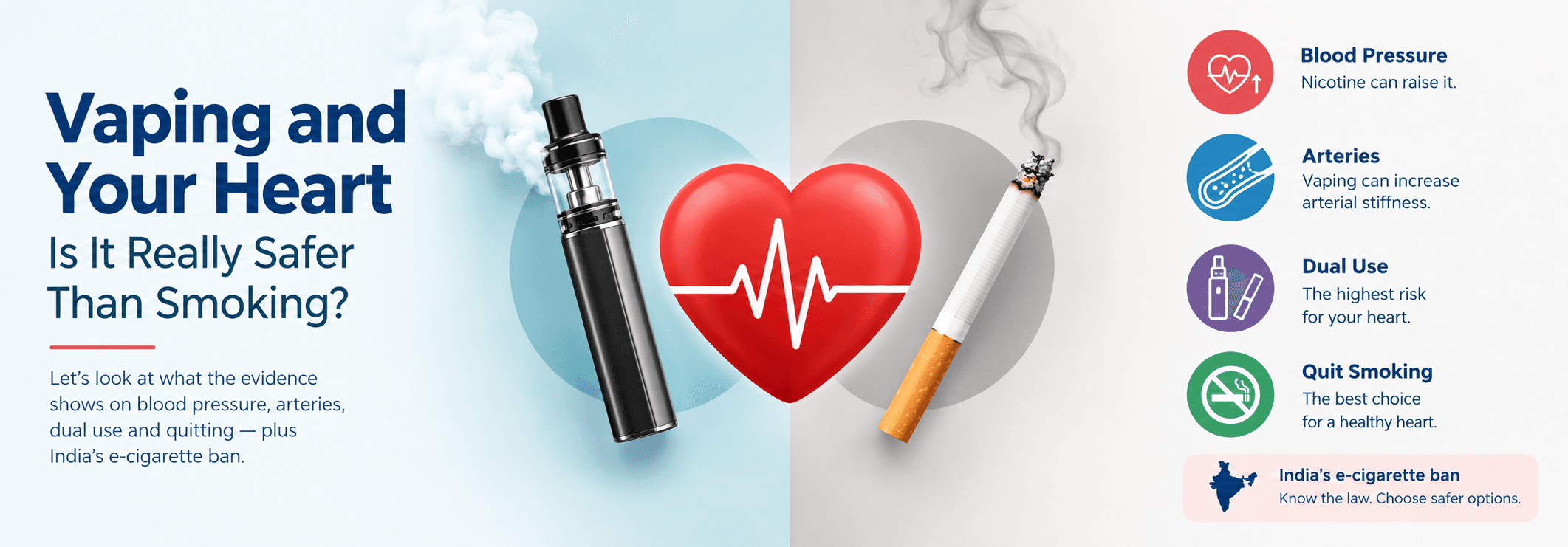


“Vaping is safer than smoking” is one of the most repeated claims in health. It isn’t entirely wrong, but it’s also not the whole story, and for your heart the details matter. In this blog, we’ll look at what the evidence actually shows about vaping and cardiovascular health, how it compares with cigarettes, why using both is the worst combination, and what the best choice is if you’re trying to protect your heart.
What Is in a Vape?
Most e-cigarettes heat a liquid containing nicotine, flavorings, and solvents such as propylene glycol into an aerosol you inhale. Unlike cigarettes, nothing is burned, so vapes don’t produce tar or as much carbon monoxide. But the aerosol is not “just water vapor.” It carries nicotine, which directly affects the heart and blood vessels, along with other chemicals whose long-term effects are still being studied.
What Vaping Does to Your Heart and Arteries
Fact: Research shows that e-cigarette use acutely raises heart rate and blood pressure, and arterial stiffness, a marker of blood vessel damage, increases within about five minutes of use (source: PMC).
Other effects reported in studies include:
- Reduced heart rate variability and impaired blood vessel function
- Platelet activation, which makes clots more likely
- Heart rhythm disturbances in laboratory studies of flavored and solvent-based aerosols
- A 19% higher risk of heart failure in one large cohort of e-cigarette users
Most of the evidence comes from short-term or observational studies, so it shows associations rather than proven cause. Vaping has also only been widely used for about a decade, which is too short to see decades of heart disease outcomes.
So, Is Vaping Safer Than Smoking?
The honest answer is probably less harmful, but not harmless, and the evidence is mixed.
What supports “less harmful”:
- A 2025 review concluded that e-cigarettes may offer harm-reduction potential compared with traditional cigarettes, but are not harmless to the heart or lungs (source: American Journal of Physiology).
- Smokers who fully switched had lower nicotine exposure and average heart rates in one study, and in two studies blood pressure fell after switching, though the certainty of this evidence is low to very low (sources: JAHA, Internal and Emergency Medicine).
- A 2025 network meta-analysis found that only cigarette use and dual use were significantly associated with heart attack and stroke when each was assessed on its own (source: Tobacco Induced Diseases).
What cautions against “safe”:
- Both vaping and smoking raise arterial stiffness and oxidative stress, with vaping somewhat lower in one meta-analysis (source: PMC).
- One vascular study found e-cigarette users had a similar rise in arterial stiffness as combustible cigarette users (source: JAHA).
- A meta-analysis reported 44% higher odds of heart attack among current e-cigarette users versus non-users, though many of these users also smoked or used to (source: PMC).
- Long-term cardiovascular outcomes are still unknown.
In short: compared with continuing to smoke, switching completely may lower some risks. Compared with not using nicotine at all, vaping is worse.
The Biggest Problem: Dual Use
Fact: Many people who vape also keep smoking, and this combination looks the worst for the heart. A meta-analysis found that dual users had about 2.5 times the odds of cardiovascular disease compared with people who used neither (source: ScienceDirect). The network meta-analysis above ranked dual use as the highest-risk category, even above cigarettes alone.
Why It’s Important: Using a vape “to cut down” while still smoking adds nicotine and chemical exposure without removing the harm of smoke. The heart benefit comes only from stopping cigarettes completely.
Who Should Be Especially Careful
- People with existing heart disease, high blood pressure, or arrhythmias: Nicotine raises heart rate and blood pressure, which can strain an already vulnerable heart.
- Anyone who has never smoked: Vaping adds risk without any benefit, and nicotine is highly addictive.
- Young people: The teenage brain and blood vessels are especially sensitive to nicotine, and our blog on why heart disease is no longer just an old-age problem explains how risk factors like these show up earlier now.
- People who already use stimulants: Combining nicotine with energy drinks or caffeine can stack the effect on heart rate. See our post on energy drinks and heart rhythm problems.
Indian Context: A Ban, But Not an Absence
India banned the production, manufacture, import, export, transport, sale, distribution, storage, and advertisement of e-cigarettes under the Prohibition of Electronic Cigarettes Act, 2019, citing concerns about youth uptake and limited long-term safety data. Repeat violations risk up to three years in jail and a fine of up to ₹5 lakh (source: TechCrunch). Sources differ on whether using or possessing a device for personal use is itself an offence, so check current law rather than assuming.
Despite the ban, vapes remain available through informal channels, and use among young people is a concern. India’s 2019 Global Youth Tobacco Survey found e-cigarette use in 3.4% of boys and 2.1% of girls aged 13 to 15, and awareness of e-cigarettes in more than a quarter of this age group (source: PMC).
Because legal vaping products aren’t available as a quitting aid in India, the realistic routes are the proven ones below.
If You Smoke, What’s the Best Way to Protect Your Heart?
- Aim to stop nicotine completely. This is the only option with a clearly established heart benefit. Our guides on the impact of smoking on heart health and quitting smoking explain how your arteries recover over time.
- Ask your doctor about proven quit aids, such as nicotine replacement therapy (patches, gum, lozenges) or prescription medicines, combined with counselling. These are regulated, dose-controlled, and have strong evidence behind them.
- Avoid dual use. Don’t replace some cigarettes with a vape and call it progress.
- Tell your doctor if you have heart disease. Quit plans for heart patients should be supervised.
- Support, don’t shame. Relapses are common. Each quit attempt builds the odds of success.
In Conclusion
Vaping is probably less harmful than smoking for a person who switches completely, but “less harmful” is a long way from “safe.” Nicotine still pushes up heart rate and blood pressure, vaping stiffens arteries, and the long-term picture is unknown. Using both vapes and cigarettes appears to be the worst of all. For your heart, the best choice is to avoid nicotine altogether, and if you smoke now, to quit completely with proven support.
Key Takeaways
- Vaping raises heart rate, blood pressure, and arterial stiffness within minutes of use.
- It is probably less harmful than smoking for those who switch fully, but not safe, and the evidence on long-term outcomes is limited and mixed.
- Dual use (vaping plus smoking) is associated with the highest cardiovascular risk, around 2.5 times higher odds of heart disease than non-use in one meta-analysis.
- People who have never smoked should not start vaping, and heart patients should be especially cautious.
- India has banned e-cigarettes since 2019; proven quit aids like nicotine replacement and counselling are the better route to stopping.
- The best protection for your heart is no nicotine at all.
References
- American Journal of Physiology: The Impact of E-Cigarettes Versus Traditional Cigarettes on Long-Term Cardiopulmonary Outcomes
- PMC: Cardiovascular Consequences of E-Cigarettes: A New Challenge for Cardiologists
- Tobacco Induced Diseases: Electronic Cigarettes and Cardiovascular Diseases: An Updated Systematic Review and Network Meta-Analysis
- ScienceDirect: E-Cigarette Use and Cardiovascular Disease: A Meta-Analysis of Exclusive and Dual Use
- Journal of the American Heart Association: Twenty-Four-Hour Cardiovascular Effects of Electronic Cigarettes Compared With Cigarette Smoking in Dual Users
- PMC: Awareness and Use of E-Cigarettes Among Adolescents and Their Adult Caregivers in Two Cities of India