
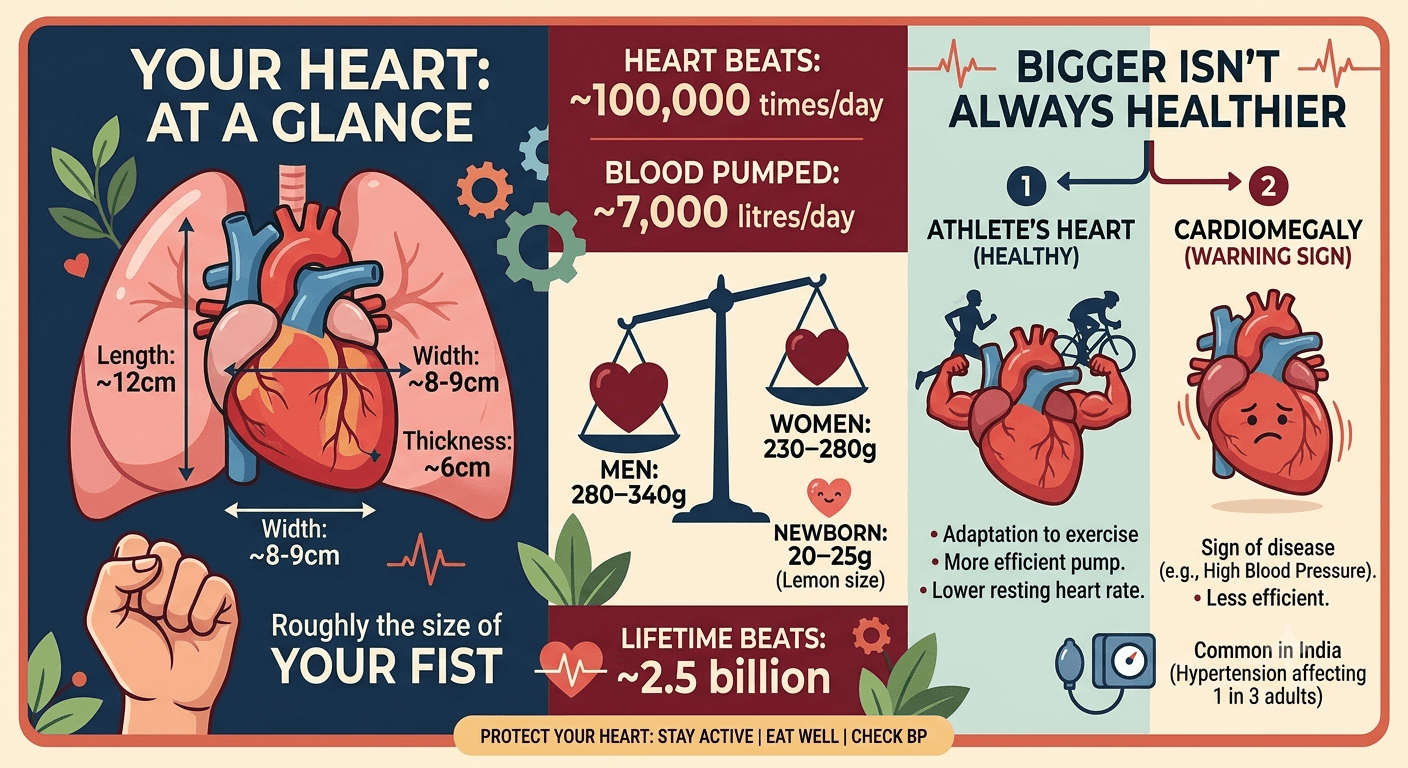


Your heart beats around 100,000 times a day without you ever having to think about it. But have you ever wondered how big it actually is, or how much it weighs? Most people picture the heart as either tiny or huge, when in reality it's a compact, incredibly efficient organ roughly the size of your own clenched fist. In this blog, we'll explore the real size and weight of the human heart, how it differs between men and women, how it changes with age and fitness, and why these numbers matter for your heart health.
How Big Is the Human Heart, Really?
The heart isn't a perfect circle or a simple pump shape - it's a cone-like, slightly asymmetrical organ tucked between the lungs, tilted toward the left side of the chest.
On average, an adult heart measures:
- Length: About 12 cm (nearly 5 inches)
- Width: About 8–9 cm (roughly 3.5 inches)
- Thickness: About 6 cm (about 2.5 inches)
That's why doctors often compare it to a clenched fist - though in truth, the fist comparison slightly underestimates its real size for most adults.
Interesting Fact: The heart sits almost at the center of the chest, not fully on the left side as many people assume. It's the tip of the heart that points left, which is why we feel our heartbeat more strongly there.
How Much Does the Heart Weigh?
On average, a healthy adult heart weighs between 250 and 350 grams (about 9 to 12 ounces) — lighter than you might expect an organ that works this hard, nonstop, for an entire lifetime.
Weight Differences Between Men and Women
Heart weight isn't identical across everyone, and one of the most consistent differences is between men and women:
- Men: 280–340 grams (10–12 oz)
- Women: 230–280 grams (8–10 oz)
This difference exists mainly because men typically have larger body frames and greater muscle mass, which means the heart has to pump blood through a bigger system.
It doesn't mean a woman's heart works any less efficiently — it's simply built to scale with a smaller body.
How a Baby's Heart Compares
A newborn's heart weighs only around 20–25 grams — smaller than a lemon — yet it's fully capable of sustaining life from the very first breath.
The heart grows steadily throughout childhood and adolescence, reaching its adult size and weight by early adulthood.
Interesting Fact: Even though a newborn's heart is tiny, it beats much faster than an adult's — often 120 to 160 times per minute, compared to 60 to 100 in adults.
Does a Bigger Heart Mean a Healthier Heart?
Not necessarily — and this is one of the most important things to understand about heart size and weight.
A heart that's heavier or larger isn't automatically a stronger one.
There are two very different reasons a heart might grow:
1. Athlete's Heart (A Healthy Adaptation)
People who do regular endurance exercise — running, swimming, cycling — often develop what's called an "athlete's heart." Their heart chambers enlarge slightly and the heart muscle thickens as a healthy response to consistent physical demand. This allows the heart to pump more blood with each beat, often resulting in a lower resting heart rate.
2. Cardiomegaly (A Warning Sign)
On the other hand, an enlarged heart can also be a sign of disease.
Conditions like long-term high blood Pressure, valve disease, or weakened heart muscle can force the heart to thicken or stretch abnormally.
Unlike an athlete's heart, this kind of enlargement often reduces the heart's efficiency rather than improving it.
Indian Context: With hypertension affecting roughly 1 in 3 adults in India according to The Lancet, unmanaged high blood pressure is one of the most common everyday causes of an unhealthy enlarged heart.Regular blood pressure checks are one of the simplest ways to catch this early.
What Affects Heart Size and Weight?
Several natural factors influence how big your heart is and how much it weighs:
- Body size: Taller, larger-framed individuals generally have proportionally larger hearts.
- Age: The heart grows through childhood and can undergo subtle changes with aging, such as mild thickening of the heart walls.
- Fitness level: Regular cardiovascular exercise can healthily increase heart size over time.
- Underlying health conditions: High blood pressure, valve disorders, and cardiomyopathy can all alter heart size in ways that need medical attention.
- Sex: As covered above, men's hearts are, on average, somewhat larger and heavier than women's.
Fun Facts About Your Heart's Size and Work
- Despite weighing less than a kilogram, your heart pumps roughly 5 litres of blood every minute — that's over 7,000 litres a day.
- Over an average lifetime, your heart beats around 2.5 billion times.
- The left ventricle is the thickest and most muscular chamber, since it has to pump blood all the way around the body — while the right ventricle only pumps blood a short distance to the lungs.
Why This Matters for Your Heart Health
Understanding your heart's normal size and weight isn't just trivia — it helps you appreciate why certain habits matter so much.
A heart that's forced to work overtime due to high blood pressure, high cholesterol, or a sedentary lifestyle can gradually change shape in ways that reduce its efficiency over the years, often without any obvious symptoms until later.
The good news is that keeping your heart at a healthy size largely comes down to familiar, everyday habits:
- Stay physically active — even 30 minutes of moderate activity a day supports healthy heart function.
- Eat a heart-friendly diet rich in vegetables, whole grains, and healthy fats.
- Get your blood pressure checked regularly, especially if there's a family history of heart disease.
- Avoid smoking, which puts extra strain on the heart and blood vessels over time.
You may also read Is Hidden Heart Risks in Healthy-Looking People
Key Takeaways
- The average adult heart weighs 250–350 grams and is roughly the size of a clenched fist.
- Men's hearts are typically heavier (280–340g) than women's (230–280g), mainly due to body size differences.
- A newborn's heart weighs just 20–25 grams and grows steadily into adulthood.
- Heart enlargement can be a healthy adaptation (athlete's heart) or a warning sign (cardiomegaly) — the difference matters.
- Regular exercise, a balanced diet, and routine blood pressure checks help keep your heart at a healthy size throughout life.