
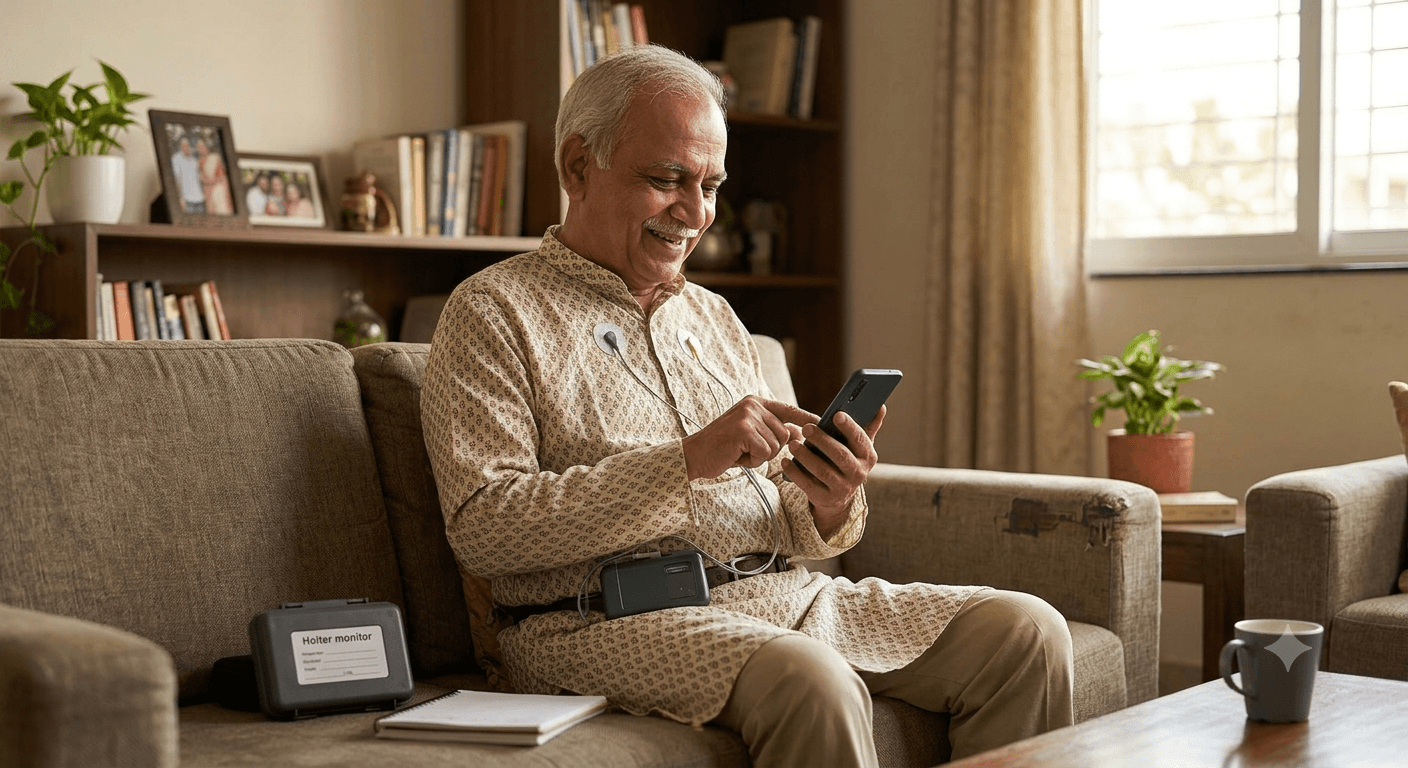


If your doctor has ever suspected an irregular heartbeat but a standard ECG came back normal, you may have been asked to wear a Holter monitor. This small, portable device tracks your heart's electrical activity continuously for a day or two, catching problems that a brief in-clinic test can easily miss. For something so simple to wear, it plays a surprisingly powerful role in diagnosing hidden heart rhythm problems.
In this blog, we'll explain what a Holter monitor is, how it works, what it's used for, and what to expect if your doctor recommends one.
What Is a Holter Monitor?
A Holter monitor is a small, battery-powered device that records your heart's electrical activity continuously for 24 to 48 hours (sometimes longer) while you go about your normal daily routine. It's a type of ambulatory electrocardiogram (ECG) - "ambulatory" simply means it monitors you while you move around, rather than while lying still in a clinic.
Fact: The device is named after Dr. Norman Holter, whose work on continuous ambulatory electrocardiography in the 1940s and 1960s laid the foundation for how the technology is used today (source: NCBI/StatPearls).
How a Holter Monitor Works
The Setup
- A few small sticky electrodes are placed on your chest.
- These electrodes are connected by thin wires to a small recorder, which you wear on a belt clip, in a pocket, or around your neck.
- The device continuously records your heart's rhythm for the prescribed period, usually 1-2 days.
During the Test
- You go about your usual daily activities: work, walking, light exercise as normally as possible.
- You're typically asked to keep a diary, noting the time of any symptoms like palpitations, dizziness, or chest discomfort.
- You'll need to avoid bathing, swimming, or activities that cause heavy sweating, since water can damage the device or loosen the electrodes.
After the Test
- You return the monitor to your healthcare provider, who downloads and analyzes the recorded data.
- The report is sent to your cardiologist, who reviews the heart rhythm data alongside your symptom diary to correlate any unusual heartbeats with what you were doing or feeling at the time.
What Is a Holter Monitor Used For?
Doctors typically recommend a Holter monitor when they suspect a heart rhythm problem that a short, resting ECG might not catch. Common uses include:
- Detecting arrhythmias: Irregular heartbeats such as atrial fibrillation, bradycardia (slow heart rate), or other rhythm disturbances that come and go.
- Investigating unexplained symptoms: Palpitations, dizziness, fainting spells, or unexplained fatigue that hasn't shown up on a standard ECG.
- Monitoring after a heart attack: To check for new or ongoing rhythm problems during recovery.
- Evaluating treatment effectiveness: Checking whether medication for an existing arrhythmia is working as intended.
- Assessing inadequate blood flow: In some cases, it can help detect signs suggestive of reduced blood supply to the heart muscle.
Indian Context: A large multi-center Indian study of nearly 24,000 patients who underwent 24-hour Holter monitoring found that 17.4% were diagnosed with atrial fibrillation, with many episodes lasting only around 14 minutes on average - far too brief to be reliably caught during a routine clinical visit. This highlights just how easily rhythm problems can be missed without extended monitoring, and why Holter tests are increasingly valuable in India despite being underused due to cost and access barriers.
Holter Monitor vs. Other Heart Rhythm Tests
Standard ECG
A standard ECG captures only a few seconds of your heart's activity - useful for spotting constant abnormalities, but easy to miss issues that occur only occasionally.
Event Monitors / Loop Recorders
Unlike a Holter monitor, which records continuously, an event monitor only records when you manually trigger it during symptoms - making it more suitable for infrequent episodes that might not occur within a 24-48 hour window.
Implantable Loop Recorders
For very infrequent but potentially serious arrhythmias, doctors may recommend a tiny recorder implanted under the skin, which can monitor heart rhythm continuously for months or even years.
Is Wearing a Holter Monitor Safe?
Yes, a Holter monitor is completely non-invasive and carries virtually no risk. The most common issue is mild skin irritation from the adhesive electrodes. It doesn't interfere with most daily activities apart from water exposure and, unlike some medical tests, doesn't require any recovery time afterward.
In Conclusion
A Holter monitor is a simple yet powerful tool that lets your doctor "see" your heart's rhythm as you live your everyday life, rather than relying on a brief snapshot taken in a clinic. If you've been experiencing unexplained palpitations, dizziness, or fatigue, a Holter monitor could be the key to catching a rhythm problem that would otherwise stay hidden.
Key Takeaways
- A Holter monitor records your heart's electrical activity continuously for 24 to 48 hours as you go about daily life.
- It's commonly used to detect arrhythmias, investigate unexplained palpitations or dizziness, and monitor recovery after a heart attack.
- Many rhythm problems, like atrial fibrillation, are brief and easily missed on a standard ECG, this is exactly what makes extended monitoring valuable.
- Alternatives like event monitors and implantable loop recorders are used for symptoms that occur too rarely for a 24-48 hour Holter test to capture.
- Wearing a Holter monitor is safe, painless, and doesn't require any recovery time.
References
- Cleveland Clinic: Holter Monitor: Purpose, Results & How It Works
- Merck Manual: Ambulatory Electrocardiography (Holter and Event Monitors)
- NCBI StatPearls: Holter Monitor
- PMC / Indian Heart Journal: Prevalence of Atrial Fibrillation on a 24-Hour Holter in Adult Indians