


If you've ever received an echocardiogram report, chances are one number stood out more than the rest: your ejection fraction (EF). It's often the first thing patients ask their doctor about, and for good reason - this single percentage tells you a great deal about how well your heart is pumping. But EF is also widely misunderstood, and a "normal" EF doesn't always mean your heart is completely fine. In this blog, we'll break down exactly what ejection fraction measures, what the ranges mean, and why the full picture is more nuanced than the number alone.
What Is Ejection Fraction?
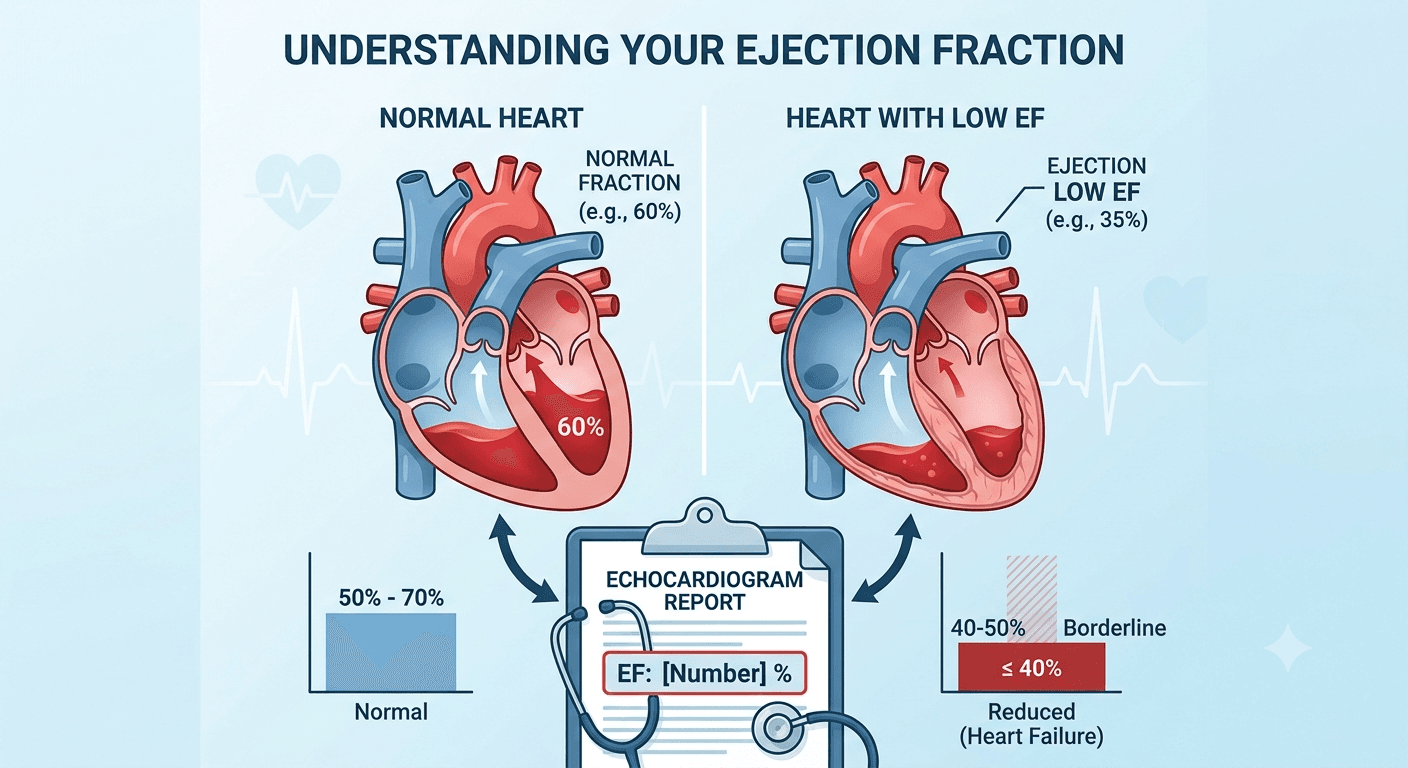
Ejection fraction measures the percentage of blood your left ventricle pumps out with each heartbeat. If your ventricle contains 100 ml of blood and pumps out 60 ml with each beat, your EF is 60%. It's one of the most important numbers your echocardiogram report will show, since it directly reflects your heart's pumping strength. For more on how the test itself works, our guide on what an echocardiogram shows covers the broader picture beyond just this one number.
What Counts as a Normal Ejection Fraction?
Fact: A normal ejection fraction typically falls between 50% and 70%, according to the American Heart Association (source: AHA). Here's how the full range breaks down:
EF Range & What It Generally Means
50–70% & Normal
41–49% & Mildly reduced (borderline)
40% or below & Reduced - usually indicates heart failure or cardiomyopathy
Why It's Important: A mildly reduced EF (41–49%) doesn't automatically mean you're developing heart failure but it can signal early heart muscle damage or elevated future risk, which is why it's worth discussing seriously with your cardiologist rather than dismissing it as a borderline, unimportant number.
The Surprising Part: You Can Have Heart Failure With a "Normal" EF
This is where EF gets genuinely confusing for many patients, and it's the single most important nuance to understand.
Fact: Doctors classify heart failure into distinct categories based on ejection fraction, and one of them - heart failure with preserved ejection fraction (HFpEF) - occurs when someone has all the classic symptoms of heart failure (breathlessness, fatigue, swelling) despite a normal-looking EF above 50% (source: American Heart Association).
HFrEF vs. HFpEF vs. HFmrEF
- HFrEF (reduced EF, ≤40%): Also called systolic heart failure - the heart muscle can't contract forcefully enough to pump adequate blood.
- HFpEF (preserved EF, ≥50%): Also called diastolic heart failure - the heart contracts normally, but the muscle has become stiff and doesn't relax properly between beats, so it can't fill with enough blood in the first place.
- HFmrEF (mildly reduced EF, 41–49%): A newer, intermediate category that can progress toward either HFrEF or HFpEF over time.
Why It's Important: This distinction genuinely changes treatment. Many of the medications proven to improve survival in HFrEF have historically shown far less benefit for HFpEF, meaning your specific EF category not just whether it's "low" or "normal" - shapes what treatment your cardiologist recommends.
Indian Context: A Younger and Different Heart Failure Pattern
Fact: Indian heart failure registries consistently show patients presenting at a notably younger age than in Western countries with mean ages around 56-61 years in major Indian registries, compared to roughly 72 years in the US ADHERE registry (source: ScienceDirect). Interestingly, a recent Indian multi-center registry found that HFpEF was notably more common among younger heart failure patients (24.6%) than in middle-aged patients, and that cardiomyopathies and rheumatic heart disease accounted for a larger share of causes in this younger group, compared to the ischemic heart disease that dominates in older patients (source: PMC).
This matters because it means a young Indian patient with a "preserved" or normal-looking EF shouldn't assume their heart is entirely healthy if they're experiencing genuine heart failure symptoms - the underlying cause and category matter just as much as the number itself.
What Can Cause a Low Ejection Fraction?
- Coronary artery disease or a prior heart attack: Damaged heart muscle tissue can't contract as effectively.
- Cardiomyopathy: Diseases of the heart muscle itself, whether genetic, viral, or related to conditions like diabetes - our post on diabetic cardiomyopathy explores one specific pathway.
- Long-standing high blood pressure: Forces the heart to work harder over time, eventually weakening it.
- Valve disease: Leaking or narrowed valves make the heart work inefficiently, which can lower EF over time.
- Arrhythmias: Certain persistent abnormal heart rhythms can reduce pumping efficiency.
Can Ejection Fraction Improve?
Yes and this is genuinely encouraging news for many patients. Doctors now recognize a specific category called HFimpEF (heart failure with improved ejection fraction), defined as a rise from 40% or below to above 40%, with at least a 10-percentage-point improvement, sustained for three months or more.
Fact: In one large study, nearly 39% of patients with reduced EF went on to develop this meaningful improvement, and those who did had significantly better survival and far fewer hospitalizations than patients whose EF stayed low (source: PMC).
What You Can Do:
- Stay consistent with prescribed heart failure medications - these are strongly linked to EF improvement over time.
- Attend all follow-up echocardiograms, since EF is typically re-checked periodically to track whether treatment is working.
- Don't assume a low EF is permanent - for many people, especially with early, consistent treatment, meaningful improvement is genuinely possible.
In Conclusion
Your ejection fraction number is one of the most useful figures on your echo report, but it's not the whole story. A "normal" EF doesn't rule out heart failure, and a low EF isn't always permanent. Understanding which category you fall into and, just as importantly, why is the real key to understanding your report, and it's always worth asking your cardiologist to walk you through what your specific number means for your treatment plan.Key Takeaways
- Ejection fraction measures the percentage of blood your left ventricle pumps out with each heartbeat, normally between 50% and 70%.
- An EF of 40% or below generally indicates HFrEF (reduced EF/systolic heart failure); above 50% with heart failure symptoms indicates HFpEF (preserved EF/diastolic heart failure).
- You can have heart failure with a completely normal-looking EF - HFpEF is a real, distinct condition, not a false alarm.
- Indian heart failure patients tend to be notably younger than in the West, and HFpEF is especially common among younger Indian patients.
- Nearly 39% of patients with a low EF show meaningful improvement over time with consistent treatment - a low EF is not necessarily permanent.
References
- American Heart Association: Ejection Fraction Heart Failure Measurement
- Heart Failure Matters (European Society of Cardiology): What Is Ejection Fraction, HFrEF and HFpEF?
- PMC: Clinical Characteristics, Treatment Patterns, and Outcomes of Heart Failure Across Age Groups — India
- ScienceDirect: Management Protocols for Chronic Heart Failure in India