
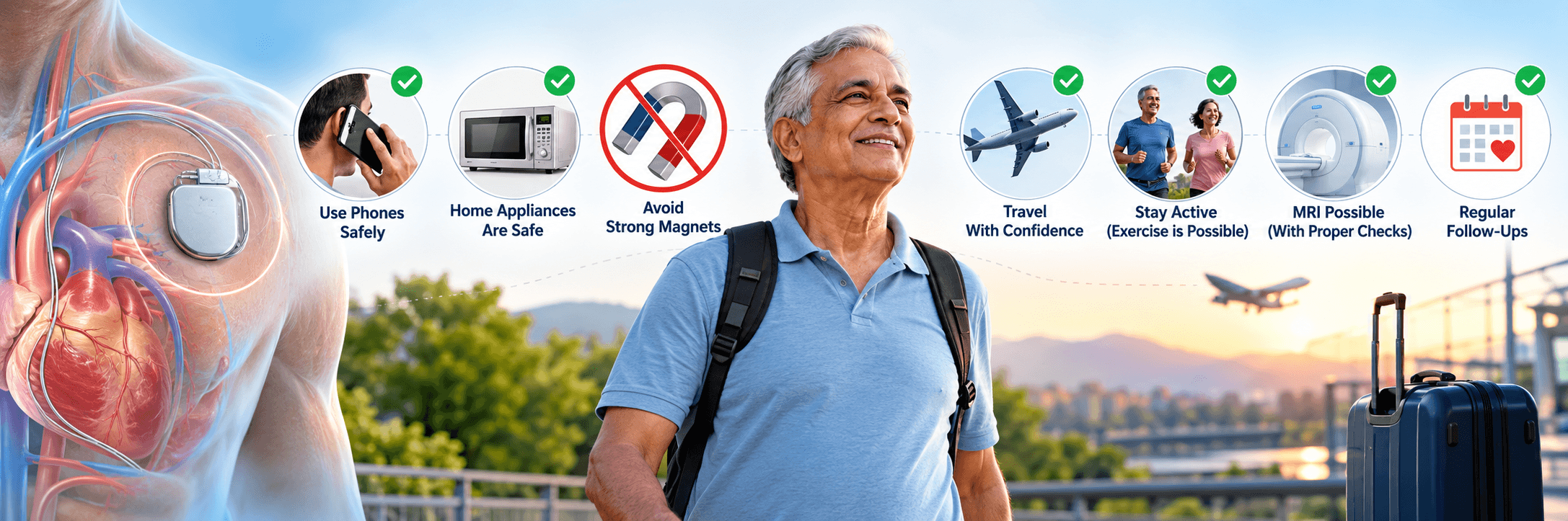


For many people, the hardest part of getting a pacemaker isn't the procedure. It's the fear of what comes after: Can I use my phone? Can I exercise? Will airport security be a problem? The reassuring answer is that modern pacemakers allow most people to return to a normal, active life, with a handful of simple precautions. In this blog, we'll cover the practical dos and don'ts of daily life with a pacemaker, from the first weeks after implantation to long-term follow-up.
If you'd like to understand why pacemakers are needed in the first place, our guide on what arrhythmia is and our post on the heart's electrical system explain the conditions a pacemaker treats.
What Does a Pacemaker Actually Do?
A pacemaker is a small device placed under the skin of the chest that monitors your heartbeat and sends gentle electrical signals to the heart when it beats too slowly or skips beats. In many people, it works only as a backup, stepping in when the heart's natural rhythm falters.
Fact: Modern pacemaker batteries last about 10 years on average, and some last up to 15. When the battery runs low, replacing the generator is usually a simple outpatient procedure (source: NewYork-Presbyterian).
The First Weeks After Implantation
Why It's Important: The leads (thin wires) connecting the pacemaker to your heart need time to settle into place. Disturbing them early can affect how well the device works.
What You Can Do:
- Avoid raising the arm on the pacemaker side above your head, or reaching for high shelves, for about six weeks, or as your doctor advises.
- Keep the wound clean and dry, and avoid heavy lifting until your doctor clears you.
- Watch for fever, chills, or pain and redness at the implant site, as these can signal infection. Contact your doctor promptly if they appear.
- Ask your doctor when you can resume driving. Many people can drive again within about a week, but this depends on your condition and local rules.
Everyday Dos and Don'ts
1. Mobile Phones and Headphones
Do: Hold your phone to the ear on the side opposite your pacemaker, or use speaker or earphones.
Don't: Keep your phone, headphones, or smartwatch in a chest pocket directly over the device.
Why It's Important: Most phones are safe, but some phones, headphones, and wireless chargers contain magnets that can briefly affect a pacemaker if held very close. Experts advise keeping them at least six inches away from the device.
2. Magnets and Household Appliances
Do: Use microwaves, TVs, and most home appliances normally. Modern pacemakers are well shielded.
Don't: Rest strong magnets, such as those in some jewellery clasps, magnetic mattress pads, or neodymium magnets, against your chest. Also avoid leaning over a running car engine for long periods.
3. Airport and Store Security
Do: Show your pacemaker ID card and tell security staff you have a device. Walking through detectors is generally safe.
Don't: Linger near the detector, and ask staff to avoid a handheld wand held over your device, since it contains a magnet.
4. MRI and Medical Procedures
Do: Tell every doctor, dentist, and technician that you have a pacemaker before any procedure.
Don't: Have an MRI without checking first. Most pacemakers implanted in the last decade are MRI-compatible, but they usually need to be reprogrammed before and after the scan.
Also avoid: Heat-based physiotherapy such as diathermy, unless your cardiologist approves.
5. Exercise and Physical Activity
Do: Stay active. With your doctor's approval, walking, swimming, cycling, and even running are possible for many people with a pacemaker.
Don't: Do repetitive, forceful arm movements or contact sports without medical advice, since these can stress the leads over time.
6. Travel
Do: Carry your pacemaker ID card, a list of your medications, and your cardiologist's contact details. Our guide on traveling safely with a heart condition covers flying, high altitude, and medication timing in more detail.
7. Intimacy
If your doctor says it is safe for you to exercise, it is generally safe to resume sexual activity too. Most people with pacemakers have an active intimate life.
Follow-Up: The Habit That Matters Most
Your device needs regular checks to make sure the battery, leads, and settings are working correctly. Many modern pacemakers also support remote monitoring, which sends data from the device to your cardiac centre between visits.
What You Can Do:
- Never skip scheduled device checks, even if you feel perfectly fine.
- Keep your pacemaker ID card with you at all times.
- Report new dizziness, fainting, unusual fatigue, breathlessness, or a persistent hiccup or muscle twitching in the chest or abdomen. These can occasionally signal a device or lead problem.
- Keep taking your heart medications as prescribed. Our guide on how to take heart medicines safely covers building a reliable routine.
Pacemaker vs. ICD: A Quick Note
An implantable cardioverter-defibrillator (ICD) is a different device that can deliver a shock to stop a dangerous rhythm. Driving rules are stricter for ICDs, and doctors may advise not driving for up to six months after implantation or after a shock. Always confirm the type of device you have and follow the advice specific to it.
Indian Context: Under-Use and Cost
Fact: In Western countries, roughly 600 to 700 pacemakers are implanted per million people each year. In India, the figure is a small fraction of that, with estimates ranging from under 10 to under 20 per million. Low awareness, affordability, limited access to advanced cardiac centres, and thin insurance coverage are the main reasons cited (source: Max Healthcare).
Costs in India vary by city, hospital, and device type. A single-chamber pacemaker generally falls in the range of ₹1.8 lakh to ₹2.5 lakh, while dual-chamber devices cost more. If you or a family member has symptoms like fainting or a very slow pulse, don't delay evaluation because of cost worries. Ask your hospital about insurance, government schemes, and device options.
In Conclusion
A pacemaker is not a limitation. It is a tool that lets your heart keep a safe rhythm so you can get back to the life you want. Keep your phone away from your chest, tell every doctor about your device, avoid strong magnets, and never miss a follow-up. With these simple habits, most people with a pacemaker travel, work, exercise, and enjoy life as before.
Key Takeaways
- Most people with a modern pacemaker can return to normal daily life, including exercise, travel, and intimacy.
- Keep phones, headphones, and magnets at least six inches from the device, and avoid chest pockets.
- Tell every doctor, dentist, and security officer that you have a pacemaker, and carry your ID card.
- MRI is possible with many modern devices, but only after checking with your doctor, since reprogramming is usually needed.
- Pacemaker batteries last about 10 years on average; regular follow-ups catch battery and lead issues early.
- Watch for fever, redness at the implant site, fainting, or new breathlessness, and call your doctor promptly.
References
- Johns Hopkins Medicine: Living with a Pacemaker or Implantable Cardioverter Defibrillator (ICD)
- NHLBI (NIH): Pacemakers: Living With
- British Heart Foundation: Pacemakers: 15 Everyday Things You Can and Cannot Do
- NewYork-Presbyterian: Who Should Get a Pacemaker and What to Know About Living With One
- Max Healthcare: New Generation Pacemakers